



.svg)

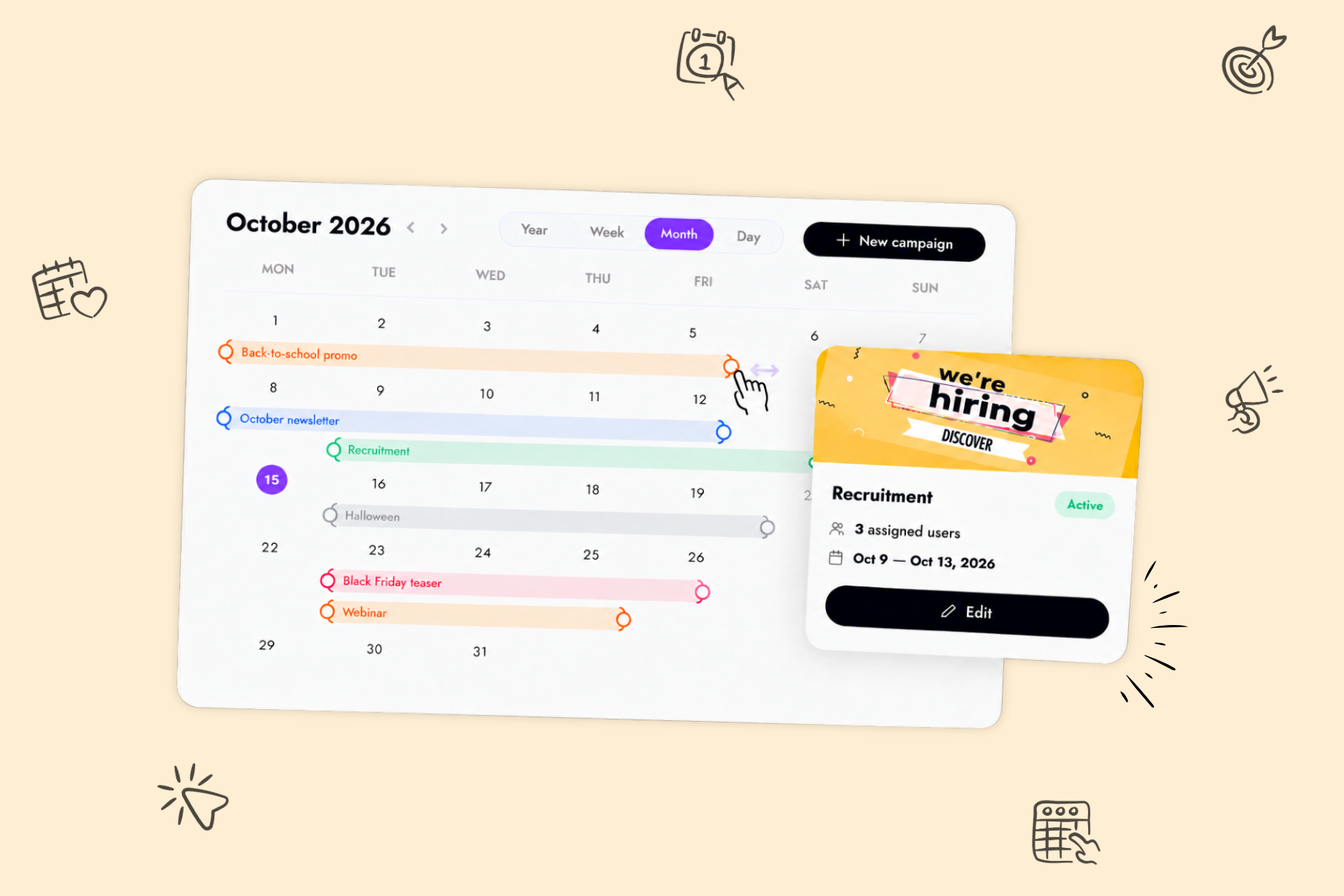

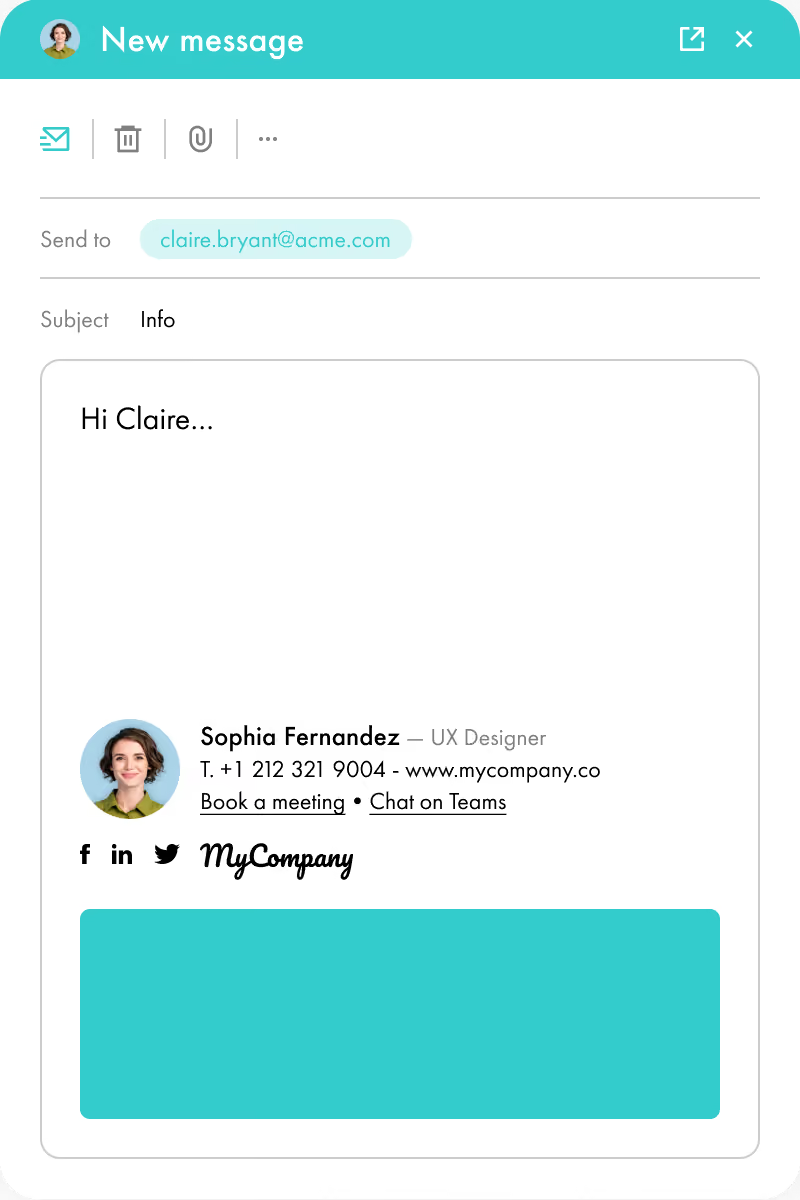
An email signature banner can promote an event, highlight a piece of content, support a product launch, share company news or reinforce internal communications. Each campaign is an opportunity for Marketing and Communications teams to turn employee email signatures into a communication channel they can activate throughout the year.
But as the number of campaigns grows, keeping track of the schedule can become more challenging. Which banners are live today? What’s coming next? Are campaigns overlapping? Are there key moments in the year that aren’t being supported by a campaign?
That’s exactly what the new Letsignit Campaign Calendar is designed for: giving Marketing and Communications teams a clear view of their email signature banner campaigns over time, directly within Letsignit.
And it’s a feature our customers have been particularly eager to see: during our latest Product Webinar, the Campaign Calendar ranked as the #1 feature they wanted us to develop next.
Noémie from SDIS13, who uses the Calendar view to manage her campaigns, shares her experience:

As Marketing and Communications teams run more campaigns through employee email signatures, creating and scheduling each campaign is only part of the equation. Teams also need a clear view of how their campaigns fit together over time.
Which messages are live right now? What’s coming next? Are multiple campaigns overlapping?
A calendar view provides a clear overview of your campaign schedule and helps address three key needs.
The calendar gives teams an at-a-glance view of past, current and upcoming campaigns.
This makes it easier to understand how different campaigns are scheduled over time, without having to open and review them one by one.
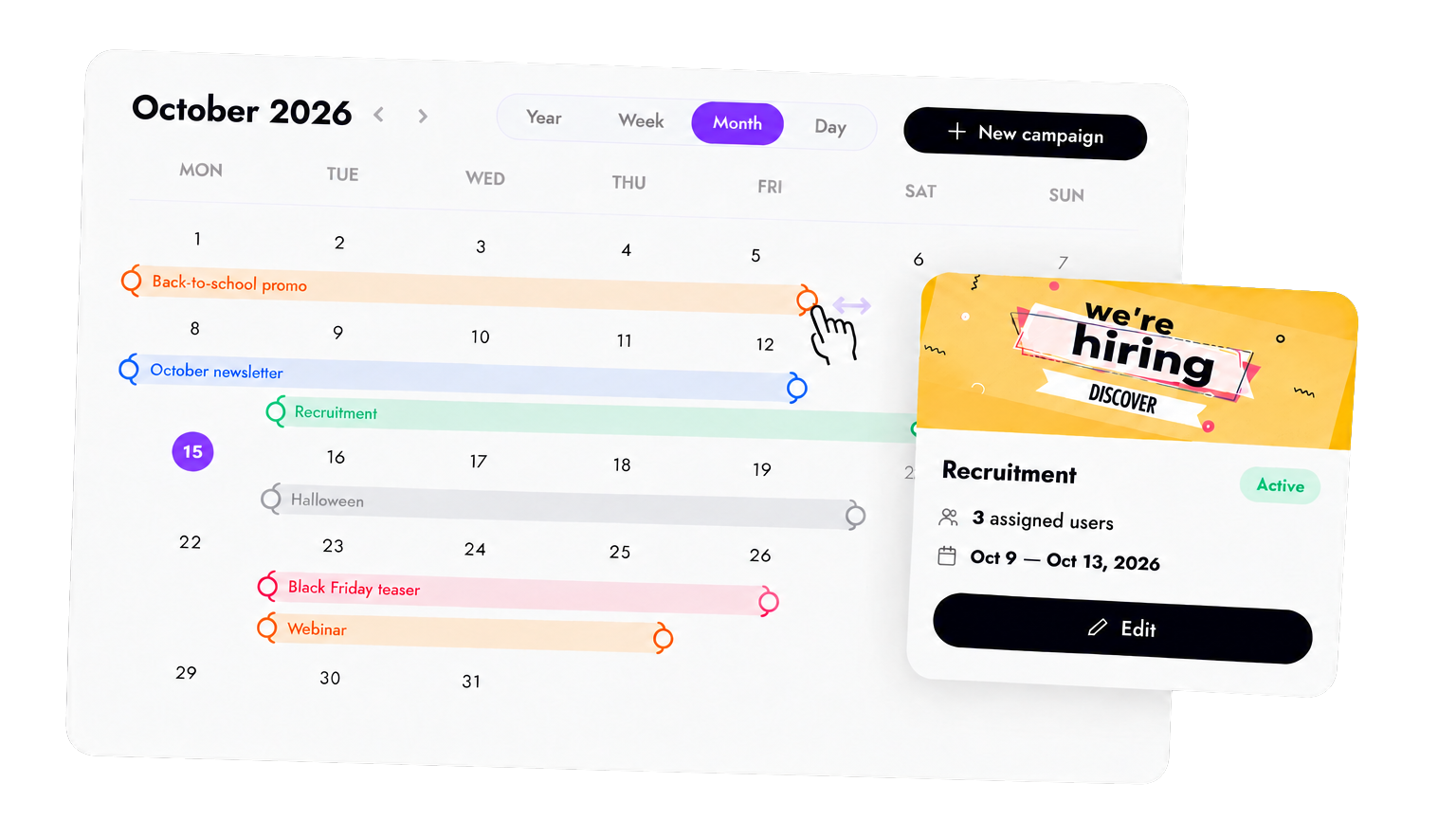
Multiple banners can run at the same time, particularly when they target different audiences. So an overlap isn’t necessarily an issue.
Having a clear view of these overlaps makes it easier to check whether your schedule makes sense. Are campaigns targeting the same audiences? Do their messages complement each other? Would one campaign be more effective at a different time?
Conversely, a period with no active campaigns is an opportunity to check whether an upcoming event, key initiative or piece of content has been overlooked.
The goal isn’t to communicate more for the sake of it, but to choose the right moments to communicate.
An event gets moved forward, an important announcement comes up or priorities suddenly shift and your communications calendar can quickly change.
A calendar view makes it easier to see how these changes affect other campaigns and adjust your schedule accordingly.
With Letsignit, Marketing and Communications teams can already create and schedule email signature banner campaigns for different audiences.
The Campaign Calendar builds on this experience by providing a visual timeline of all the campaigns configured in Letsignit.
Four different views let teams manage their schedule at the level of detail they need:
Color coding makes campaign statuses easy to identify at a glance, while search, filter and sorting options make it easier to navigate as the number of campaigns grows.
When plans change, campaign dates can also be adjusted directly from the Week and Month views, depending on the user’s permissions and the campaign status. Simply drag the edges of a campaign within the calendar to update its scheduled dates.
The Campaign Calendar is more than just a way to view your schedule: teams can take action directly from it.
From the Week and Month views, simply drag the edges of a campaign to adjust its start and end dates without leaving the calendar.
It’s a simple way to view and adjust campaign schedules from the same place, depending on the user’s permissions and the campaign status.
Every day, your employees exchange emails with customers, prospects and partners. Each of these interactions is a valuable touchpoint that can help extend the reach of your communications campaigns.
For teams already making the most of this channel, the Campaign Calendar makes day-to-day campaign management easier, helping them visualize, anticipate and adjust campaigns as priorities evolve.
And if email signature banner campaigns aren’t part of your strategy yet, now might be the right time to explore their potential.
Create → Target → Schedule → Visualize → Adjust → Track
The Campaign Calendar isn’t a standalone feature. It’s part of a broader set of tools designed to help teams turn employee email signatures into an effective Marketing and Communications channel.

Yes, with the 'Campaigns' offer, it is possible to track the number of clicks on the email signatures of all your employees in the 'Statistics' area of the platform.
You can then access a detailed or global view of the number of clicks on the email signatures of each employee. You can use the search option to target a specific signature or a given period. Finally, you have the possibility to export all statistics to an Excel document.
If you launch campaigns with banners inserted in your email signatures, you can also access their performance via this same space.
With Letsignit, you can easily add social network icons in your collaborators' email signatures and link to your company pages. Also, our "attributes" feature allows you to manage personalized URLs for each of your collaborators such as their individual LinkedIn profile.
And that's not all: you can add links to an appointment-setting application, allow your customers to leave reviews easily, and integrate our 'Chat on Teams' widget to let anyone start a discussion via Microsoft Teams chat.
It’s up to you! As an administrator of the Letsignit platform, you choose whether or not to grant modification rights to your employees. These permissions are managed on an attribute-by-attribute basis, which means that you can decide to allow the employee to change their phone number, but not the address of your premises, for example.
This feature applies to all attributes in your directory, including custom attributes created on Letsignit. When your employees change one or more attributes, your directory is obviously not affected.
It often happens that employees make their email signature their own: custom format, bad fonts, colors inconsistent with the brand standards... all of this has an impact on your brand!
A consistent visual identity is considered authentic and outperforms a perceived weak one by 20%. And, your customers are 2.4 times more likely to buy your products.
With Letsignit, take back control over your brand identity by standardizing all your email signatures. Our tool has many features that allow you to customize your signatures by department, by audience or by subsidiary. Not to mention the possibility of carrying out campaigns within your email signatures thanks to our Campaign offer.
What is the user experience like for our employees?
In both cases:
In short, they have autonomy in their email signature, but you keep control on the field, signatures, and banners they can edit or use.
With our "multi-signature" feature, your employees can benefit from multiple email signatures. No technical manipulation is required. Thanks to our Add-in for Outlook or the desktop app, they can change their email signatures as they wish with just a few clicks.
Regarding the creation of email signatures, you can make several variations such as:
Everything has been thought of to go further in the personalization process based on the recipient of your emails.
If sending emails has an impact, non-optimized email signatures also have an impact. An unsuitable format or an image that is too heavy considerably increases the size of your signatures... and therefore, your emails.
As a responsible economic actor, we contribute to reducing our CO2 emissions and those of our customers in several ways:
As we are increasingly involved in sustainability initiatives, our priority in 2023 is to develop even more green IT functionality.
If sending emails has an impact, non-optimized email signatures also have an impact. An unsuitable format or an image that is too heavy considerably increases the size of your signatures... and therefore, your emails.
As a responsible economic actor, we contribute to reducing our CO2 emissions and those of our customers in several ways:
As we are increasingly involved in sustainability initiatives, our priority in 2023 is to develop even more green IT functionality.


Lorem ipsum dolor sit amet, consectetur adipiscing elit, sed do eiusmod tempor incididunt ut labore et dolore magna aliqua. Ut enim ad minim veniam, quis nostrud exercitation ullamco laboris nisi ut aliquip ex ea commodo consequat. Duis aute irure dolor in reprehenderit in voluptate velit esse cillum dolore eu fugiat nulla pariatur.