
.svg)


In the age of Instagram reels, intelligent chatbots, and push notifications, one might assume that email has become obsolete. And yet, this communication channel is still very much alive. Email remains one of the most widely used means of exchange and communication, both for businesses and for internet users.
However, within the ocean of messages sent every day—and with spam filters becoming increasingly efficient—emails are finding it harder and harder to reach the inbox.
That is precisely why it is essential to understand and work on email deliverability. Below is a comprehensive guide to help you maximize your chances of reaching your audience and ensuring your messages actually arrive where they are meant to be read.

Behind this somewhat unusual word—almost a neologism—lies a central concept in digital communication. Email deliverability refers to the likelihood or ability of an email to successfully reach a recipient’s inbox.
The days when five emails could land effortlessly in a nearly empty inbox are long gone. The concept of deliverability emerged precisely because modern emails must now navigate a real obstacle course before reaching the inbox. Spam filters, security blockers, and other filtering technologies have become increasingly sophisticated and now impose strict limitations on incoming messages.
As a result, many communications end up in spam folders.
The goal of email deliverability is, therefore, to understand what might prevent an email from reaching its destination—often through email testing tools—and to optimize these different parameters in order to increase the chances that a message will actually be read.
Did you know that 93% of internet users check their email inbox every day? Or that the average email open rate is around 33.9%, despite increasingly saturated inboxes?
As mentioned earlier, email remains an extremely widely used communication channel.
To fully benefit from this reality, it is crucial to understand and optimize the deliverability of your emails. By doing so, you maximize the chances that your messages will be read and, therefore, that they will achieve their marketing objectives—whether that means generating clicks, encouraging conversions, prompting contact, or even driving purchases.
Remember this fundamental principle: an undelivered email is an invisible message. And an invisible message represents a lost opportunity for your customers or prospects to interact with your brand.
In other words, before even discussing open rates or click-through rates, the first priority should always be ensuring that your emails actually reach the inbox.

Generally speaking, a deliverability rate above 95% is considered good or sufficiently high.
Conversely, a rate below 90% typically indicates that deliverability is too low and that your email strategy should be reassessed.
However, it is important to remember that a good deliverability rate does not necessarily mean strong marketing performance. Deliverability should be viewed as a foundation—a prerequisite for successful email marketing.
Only after this baseline has been achieved should you analyze other metrics, such as open rates, click-through rates, conversion rates, and overall engagement.
Email deliverability depends on a combination of technical and behavioral factors. To ensure that your emails successfully reach the inbox, it is essential to understand these parameters and take them into account when designing your campaigns.
This is arguably the most important factor affecting email deliverability.
Every sending domain and IP address has a history that is accessible to email service providers. These providers can immediately see whether a brand’s domain or sending address has been associated with complaints, high bounce rates, or low engagement levels.
In other words, your reputation is visible to inbox providers.
This directly influences the level of “trust” that email messaging softwares place in your communications. Depending on the data they collect, these systems may be more or less likely to block your emails or send them directly to spam folders.
Deliverability is therefore something that must be built over time. It reflects your past practices and interactions.
Viewing things this way encourages companies to improve their communication habits—by adopting best practices for writing emails, for example, and by maintaining rigorous database management practices.
Over time, these efforts help build a positive image among your recipients and strengthen the reputation of your sending domain.
Another important factor for optimizing email deliverability is sending frequency, which includes both the regularity of your campaigns and the volume of emails you send.
From the perspective of email providers, a sudden spike in sending volume—or, on the contrary, extremely infrequent sending—can appear suspicious.
From the user’s perspective, sending too many emails may cause fatigue and lead recipients to delete your messages or mark them as spam. On the other hand, sending too few emails can weaken the relationship with your audience, making them more likely to ignore your communications.
Your challenge is, therefore, to strike the right balance between consistent communication and reasonable spacing between messages. This helps maintain recipient engagement without triggering the automated defenses of email filtering systems.
Another key factor in email deliverability is the content of the email itself, both in terms of substance and presentation.
If you take a look at your spam folder, you will inevitably find emails with a suspicious appearance—messages filled with excessive punctuation, spelling mistakes, or entire phrases written in capital letters.
This usually means that your spam filter has done its job.
Spam filtering systems are specifically designed to detect emails with suspicious content. Messages that contain too many exclamation marks, overly promotional language, or manipulative wording are often flagged automatically.
Similarly, emails containing low-quality images or broken links are frequently categorized as spam.
Beyond the purely technical dimension, emails that provide little or no value to the reader may also cause recipients to lose interest and quickly delete them. These user actions are recorded by email providers and may lead them to block future communications from the same sender.
All of this highlights the importance of crafting high-quality emails—both in terms of content and formatting—in order to maximize deliverability.
Including functional and engaging interactive elements, such as email banners or dynamic visuals, can also significantly increase the chances that your emails will reach their destination successfully.
Contact lists are often an underestimated pillar of email deliverability, yet they are absolutely essential.
Lists containing incorrect or purchased email addresses tend to increase bounce rates and spam complaints. These indicators damage the sender’s reputation and therefore negatively affect the deliverability of future campaigns.
To ensure your communications reach the right audience while respecting best practices, it is essential to implement consent-based data collection.
You should also ensure that your lists contain only valid email addresses and that your contacts are segmented appropriately according to relevant criteria.
The final element to consider—yet one that is just as important—is the level of engagement your recipients have with your emails.
As mentioned earlier, user interactions with emails send signals to email providers.
Metrics such as open rates, click-through rates, bounce rates, replies, and immediate deletions all influence the perceived credibility of the sender in the eyes of inbox providers.
For this reason, it is essential to adopt best practices that encourage positive interactions with your communications. For example, including effective calls-to-action (CTAs) within your email signatures or banners can significantly increase engagement levels.
But that is not all.

What does it actually mean to improve email deliverability in practical terms? Below are five key habits to adopt in order to ensure that your emails successfully reach their destination.
It cannot be emphasized enough: a well-designed email—both visually and in terms of content—is far more likely to be well received by both recipients and email providers.
To maximize your chances of success:
Avoid excessive capitalization and exclamation marks. Instead, opt for a subject line that is clear, transparent, and direct. A mismatch between the subject line and the content of the email can damage your credibility.
A structured and informative message with a balanced ratio of text to images will always perform better. Here are some examples of professional emails to inspire your writing.
When including links, prioritize quality over quantity. One well-chosen link is often more effective than several irrelevant ones, which may be perceived as spam by both users and filtering systems.
Since a large portion of emails are read on smartphones, your message must be optimized for mobile viewing.
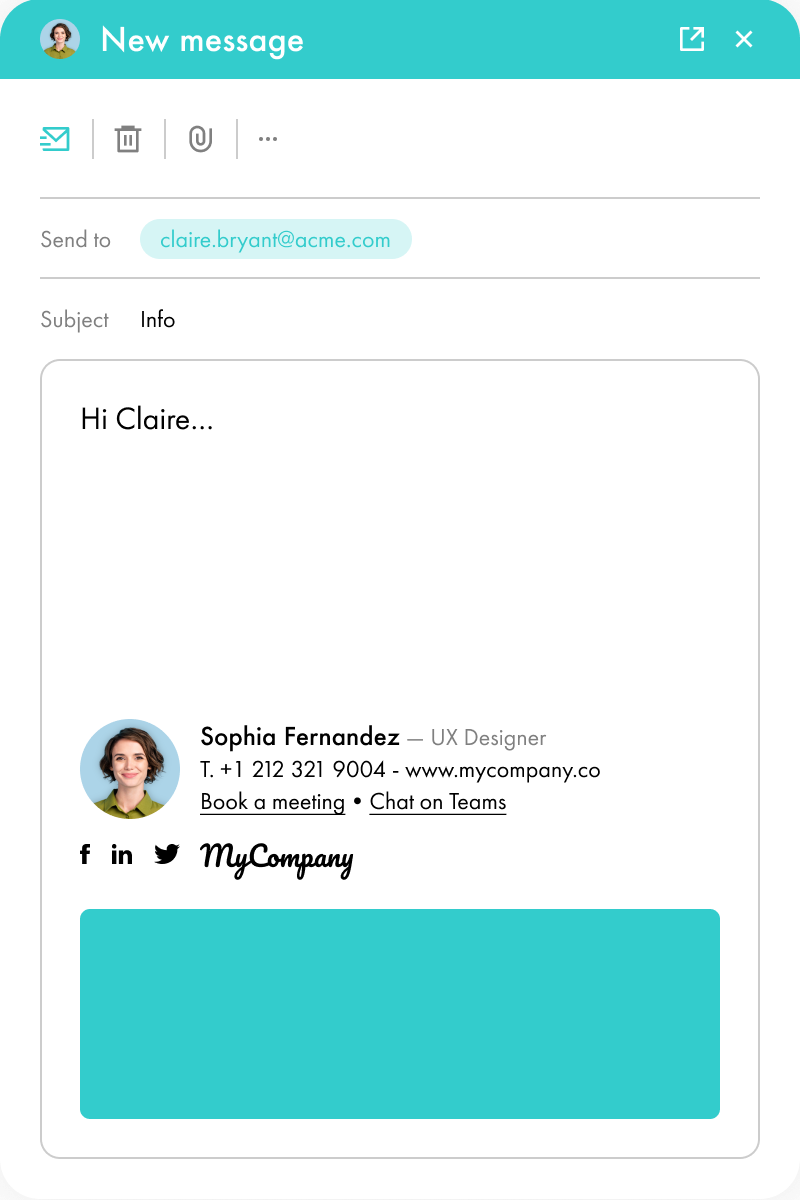
To ensure a polished email down to the smallest details, do not forget to refine your email signature using professional email signature tools.
Improving deliverability is not only about marketing—it also requires proper technical configuration.
One of the most important technical aspects is domain authentication.
As you may already know—perhaps thanks to a helpful colleague from the IT department—there are three main email authentication protocols:
These protocols verify that you are authorized to send emails from your domain. If they are not properly configured, your emails are significantly more likely to end up in spam folders.
For those who are less comfortable with technical settings, there is no need to worry. Most email service providers and marketing platforms offer step-by-step guidance to help you configure these protocols correctly.
Remember: email providers monitor both bounce rates and recipient engagement.
For this reason, maintaining a clean and up-to-date contact database is essential.
You should regularly remove:
One effective strategy for refining your list is to send a re-engagement email. This type of message specifically targets inactive contacts and asks them to confirm whether they are still interested in hearing from your brand.
If they do not respond, it may be best to remove them from your database.
Your contacts are like snowflakes—numerous, yet each one unique.
Every recipient has their own preferences, demographic profile, and relationship with your brand. For this reason, it is essential to segment your contact database into homogeneous groups based on demographic and behavioral criteria.
For example, you might segment contacts according to:
This type of segmentation allows you to deliver more relevant and personalized communications, which, in turn, increases open rates and engagement levels.
To make your emails even more appealing, you can also include a professional email signature containing links tailored to your audience.
As you might expect, these positive engagement signals are recorded by email providers and contribute to improved deliverability over time.
Trying to improve something you have not measured is a bit like changing a cookie recipe before even tasting the first batch.
To refine your email strategy, you need feedback.
Track your key performance indicators, including:
Based on these insights, you can adjust your strategy by modifying your campaigns, refining audience segments, or improving the content of your messages.

Several tools are specifically designed to evaluate email deliverability according to different technical and marketing criteria.
Some of the most commonly used platforms include:
*****
Email deliverability should not be viewed as an end in itself, but rather as the foundation of a successful email marketing strategy.
A strong deliverability rate—meaning a high percentage of emails reaching the inbox—significantly increases your chances of reaching your target audience.
To further strengthen engagement, consider integrating strategic elements such as professional email signatures, clear calls to action, and personalized messaging.

Yes, with the 'Campaigns' offer, it is possible to track the number of clicks on the email signatures of all your employees in the 'Statistics' area of the platform.
You can then access a detailed or global view of the number of clicks on the email signatures of each employee. You can use the search option to target a specific signature or a given period. Finally, you have the possibility to export all statistics to an Excel document.
If you launch campaigns with banners inserted in your email signatures, you can also access their performance via this same space.
With Letsignit, you can easily add social network icons in your collaborators' email signatures and link to your company pages. Also, our "attributes" feature allows you to manage personalized URLs for each of your collaborators such as their individual LinkedIn profile.
And that's not all: you can add links to an appointment-setting application, allow your customers to leave reviews easily, and integrate our 'Chat on Teams' widget to let anyone start a discussion via Microsoft Teams chat.
It’s up to you! As an administrator of the Letsignit platform, you choose whether or not to grant modification rights to your employees. These permissions are managed on an attribute-by-attribute basis, which means that you can decide to allow the employee to change their phone number, but not the address of your premises, for example.
This feature applies to all attributes in your directory, including custom attributes created on Letsignit. When your employees change one or more attributes, your directory is obviously not affected.
It often happens that employees make their email signature their own: custom format, bad fonts, colors inconsistent with the brand standards... all of this has an impact on your brand!
A consistent visual identity is considered authentic and outperforms a perceived weak one by 20%. And, your customers are 2.4 times more likely to buy your products.
With Letsignit, take back control over your brand identity by standardizing all your email signatures. Our tool has many features that allow you to customize your signatures by department, by audience or by subsidiary. Not to mention the possibility of carrying out campaigns within your email signatures thanks to our Campaign offer.
What is the user experience like for our employees?
In both cases:
In short, they have autonomy in their email signature, but you keep control on the field, signatures, and banners they can edit or use.
With our "multi-signature" feature, your employees can benefit from multiple email signatures. No technical manipulation is required. Thanks to our Add-in for Outlook or the desktop app, they can change their email signatures as they wish with just a few clicks.
Regarding the creation of email signatures, you can make several variations such as:
Everything has been thought of to go further in the personalization process based on the recipient of your emails.
If sending emails has an impact, non-optimized email signatures also have an impact. An unsuitable format or an image that is too heavy considerably increases the size of your signatures... and therefore, your emails.
As a responsible economic actor, we contribute to reducing our CO2 emissions and those of our customers in several ways:
As we are increasingly involved in sustainability initiatives, our priority in 2023 is to develop even more green IT functionality.
If sending emails has an impact, non-optimized email signatures also have an impact. An unsuitable format or an image that is too heavy considerably increases the size of your signatures... and therefore, your emails.
As a responsible economic actor, we contribute to reducing our CO2 emissions and those of our customers in several ways:
As we are increasingly involved in sustainability initiatives, our priority in 2023 is to develop even more green IT functionality.
To test the deliverability of an email, you can use one of the specialized solutions mentioned above or rely on the diagnostic tools integrated into your email marketing platform.
In summary, the main factors influencing email deliverability include:
To truly improve the effectiveness of your email marketing campaigns, you need to combine strong writing practices, solid technical configuration, and relevant audience segmentation—while continuously analyzing performance data to refine your strategy.
A deliverability audit generally includes:
While the concept is usually applied to emails themselves, deliverability can also refer to a specific email address.
In this case, it describes the ability of that address to have its messages successfully delivered to recipients’ inboxes, depending on its reputation and sending history.


Lorem ipsum dolor sit amet, consectetur adipiscing elit, sed do eiusmod tempor incididunt ut labore et dolore magna aliqua. Ut enim ad minim veniam, quis nostrud exercitation ullamco laboris nisi ut aliquip ex ea commodo consequat. Duis aute irure dolor in reprehenderit in voluptate velit esse cillum dolore eu fugiat nulla pariatur.