



.svg)


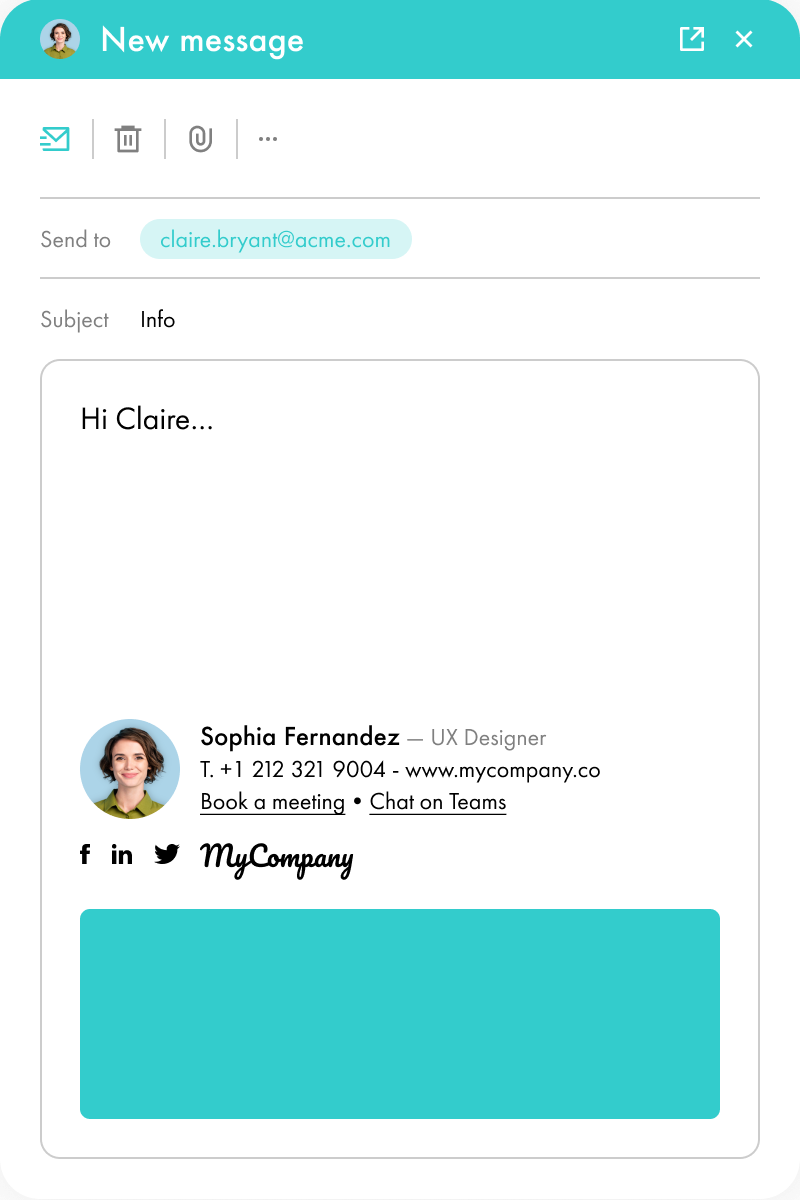
You’ve just written an email that, frankly, would make the inventor of email proud. But just as you’re about to hit Send, something feels off: the bottom of your message looks a little bare, or worse, still displays that old generic signature...
Don’t panic! Setting up a professional email signature in Microsoft Outlook is easy once you know where to look. Whether you’re using the desktop app, Outlook on the web, or mobile tools, taking care of your email footer can significantly improve your professional communications.
In this practical guide, we’ll show you step by step how to create, set up, and customize your email signature in Outlook.
There are two main ways to create an email signature in Outlook: you can build it directly using Microsoft’s built-in tools, or use an external signature generator for a more advanced design.
Outlook’s built-in signature editor lets you quickly create a professional signature without leaving your email client. This option is particularly useful if you’re just starting out and looking for a simple, straightforward solution.
Here’s how to do it:
Outlook’s built-in signature editor has some limitations, both technically and visually. If you want to take your design further, an external tool can give you more flexibility.
Microsoft Word, for example, offers email signature templates that you can customize with your contact details, logo, and links before copying the finished design into Outlook.
If you’re looking for a more design-focused approach, tools such as Canva or Adobe Express also offer customizable email signature templates. These platforms give you greater control over font colors, images, and layouts, without requiring you to write any code.
Finally, for organizations managing signatures for multiple employees, a dedicated signature management solution such as Letsignit can make deployment much easier. It allows you to centralize signature design, synchronize employee information, and roll out brand guidelines across devices with just a few clicks. Your teams don’t need to handle the deployment manually.
Once your design is finalized, adding it to Outlook only takes a few steps.
Whether you want to add a signature manually to a specific email or automatically include one in every message, Outlook makes the process straightforward.
Would you rather choose your signature manually and add it only when needed? You can do this directly from the message composer.
Your contact details will then be added without changing the rest of your email.
To avoid adding your signature manually every time you send an email, you can set one as your default signature.
That’s it!
Your phone number has changed, your job title has been updated, or your brand identity has had a makeover? It’s time to update your signature.
Fortunately, changing an Outlook email signature only takes a couple of minutes.
To update your contact information, follow these steps:
Your future emails will now include your updated contact information.
You’ve written a specific email and your usual signature doesn’t quite fit? No problem. Even if your default signature is automatically inserted when you open the compose window, you can switch to another signature whenever you need to.
The exact steps vary slightly depending on which version of Outlook you’re using:
As soon as you select the new signature, it replaces the existing block at the bottom of your message while leaving the rest of your email untouched.
If you want to send a message without a signature, simply select the existing signature block and delete it manually.
Creating an eye-catching email signature is all about finding the right balance between visual appeal and technical constraints. Here are five best practices to help you create an effective Outlook signature.
When making initial contact or sending a first message, a complete signature containing your name, logo, links, and banners can be useful. It showcases your expertise and brand identity while giving recipients the information they need to connect with you.
Once the introductions are out of the way, however, you don’t necessarily need to include all that information.
After five or six back-and-forth messages in the same thread, repeating a large signature block can make the conversation harder to read.
Consider creating a streamlined version of your signature for replies, containing only essential information such as your first and last name and direct phone number.
Your audience includes people with different needs: colleagues who already know you and want to keep up with company news, prospects who haven’t met you yet, and international contacts who may not speak your language.
To make every interaction as effective as possible, prepare several signatures, for example:
To roll out these versions across an organization while maintaining a consistent brand image, a centralized signature management solution such as Letsignit can simplify day-to-day administration.
What you see in Outlook’s editor doesn’t always perfectly reflect what your recipient will see. Some email clients automatically apply dark mode, while others may block images from loading automatically.
Before rolling out your new signature to all your contacts, send test emails to a variety of external inboxes, such as Gmail, Apple Mail on a smartphone, and a webmail interface.
Check that your spacing, fonts, images, and links still look correct in different environments.
To reduce the risk of formatting problems and unnecessarily heavy emails, keep your design simple: your essential contact information, one or two images, your links, and your signature may already be more than enough.
From a technical perspective, avoid creating your entire signature as a single large image. If images are disabled, the text won’t be selectable or readable.
Instead, use a combination of live text and graphic elements, with optimized images to keep the email lightweight.
The process for creating an email signature in Outlook can vary depending on the version you’re using.
Menus and options are presented differently in classic Outlook for Windows, new Outlook, Outlook on the web, and Outlook for Mac. Microsoft also continues to update the new Outlook interface, including its signature settings.
Before you get started, check which Outlook environment you’re using. If a command mentioned in this guide doesn’t appear where expected, look for a Signatures option in your Outlook settings. Its location can vary depending on your version.
*****
See? Creating and adding an email signature in Outlook really isn’t complicated.
Whether you create it manually or copy and paste it from an external design tool, your email signature can help you build stronger connections with your audience.
Want to keep improving your Outlook skills? Discover our guide on how to schedule an email in Outlook.

Yes, with the 'Campaigns' offer, it is possible to track the number of clicks on the email signatures of all your employees in the 'Statistics' area of the platform.
You can then access a detailed or global view of the number of clicks on the email signatures of each employee. You can use the search option to target a specific signature or a given period. Finally, you have the possibility to export all statistics to an Excel document.
If you launch campaigns with banners inserted in your email signatures, you can also access their performance via this same space.
With Letsignit, you can easily add social network icons in your collaborators' email signatures and link to your company pages. Also, our "attributes" feature allows you to manage personalized URLs for each of your collaborators such as their individual LinkedIn profile.
And that's not all: you can add links to an appointment-setting application, allow your customers to leave reviews easily, and integrate our 'Chat on Teams' widget to let anyone start a discussion via Microsoft Teams chat.
It’s up to you! As an administrator of the Letsignit platform, you choose whether or not to grant modification rights to your employees. These permissions are managed on an attribute-by-attribute basis, which means that you can decide to allow the employee to change their phone number, but not the address of your premises, for example.
This feature applies to all attributes in your directory, including custom attributes created on Letsignit. When your employees change one or more attributes, your directory is obviously not affected.
It often happens that employees make their email signature their own: custom format, bad fonts, colors inconsistent with the brand standards... all of this has an impact on your brand!
A consistent visual identity is considered authentic and outperforms a perceived weak one by 20%. And, your customers are 2.4 times more likely to buy your products.
With Letsignit, take back control over your brand identity by standardizing all your email signatures. Our tool has many features that allow you to customize your signatures by department, by audience or by subsidiary. Not to mention the possibility of carrying out campaigns within your email signatures thanks to our Campaign offer.
What is the user experience like for our employees?
In both cases:
In short, they have autonomy in their email signature, but you keep control on the field, signatures, and banners they can edit or use.
With our "multi-signature" feature, your employees can benefit from multiple email signatures. No technical manipulation is required. Thanks to our Add-in for Outlook or the desktop app, they can change their email signatures as they wish with just a few clicks.
Regarding the creation of email signatures, you can make several variations such as:
Everything has been thought of to go further in the personalization process based on the recipient of your emails.
If sending emails has an impact, non-optimized email signatures also have an impact. An unsuitable format or an image that is too heavy considerably increases the size of your signatures... and therefore, your emails.
As a responsible economic actor, we contribute to reducing our CO2 emissions and those of our customers in several ways:
As we are increasingly involved in sustainability initiatives, our priority in 2023 is to develop even more green IT functionality.
If sending emails has an impact, non-optimized email signatures also have an impact. An unsuitable format or an image that is too heavy considerably increases the size of your signatures... and therefore, your emails.
As a responsible economic actor, we contribute to reducing our CO2 emissions and those of our customers in several ways:
As we are increasingly involved in sustainability initiatives, our priority in 2023 is to develop even more green IT functionality.
Open the signature settings via File > Options > Mail > Signatures in classic Outlook for Windows, or via Settings > Accounts > Signatures in new Outlook and Outlook on the web.
From there, you can create your signature, add links and images, and choose when Outlook should insert it automatically.
Open the Signatures section in your Outlook settings. Select the signature you want to edit, make your changes directly in the signature editor, and select Save.
In classic Outlook for Windows, select Save and then OK to apply your changes.
Although the terms are often confused in workplace conversations, an email signature and an electronic signature for a document are two different things.
If you need to formally sign a quote, contract, or another document, use an appropriate electronic signature solution that meets the security and legal requirements of the document, then attach the signed document to your email.
You can find email signature examples and templates on platforms such as Microsoft Word, Canva, and Adobe Express. These can help you find inspiration for layouts, colors, fonts, and branding elements.
It depends on your needs. For a simple signature, Outlook’s built-in editor is usually enough. For more advanced designs, tools such as Canva or Adobe Express offer greater flexibility, while dedicated solutions like Letsignit are better suited to businesses managing signatures across multiple employees.


Lorem ipsum dolor sit amet, consectetur adipiscing elit, sed do eiusmod tempor incididunt ut labore et dolore magna aliqua. Ut enim ad minim veniam, quis nostrud exercitation ullamco laboris nisi ut aliquip ex ea commodo consequat. Duis aute irure dolor in reprehenderit in voluptate velit esse cillum dolore eu fugiat nulla pariatur.

