.svg)

.png)

Imagine an orchestra where every musician played their own score, at their own pace, without a conductor... A cacophony is certainly already echoing in your head!
In business, that is exactly what happens when brand governance is lacking. At a time when customer touchpoints are multiplying (social media, emails, websites, events, advertising), maintaining a unified image becomes a monumental challenge.
Far more than a simple administrative constraint, brand governance is the driving force that enables a strategic vision to be transformed into a customer experience that is both memorable and consistent. It ensures that, regardless of the person they are speaking to or the channel they are using, the company’s voice continues to resonate with its audience over time.
In this guide, we explore how to structure your brand governance to make your organization shine.
Brand governance (less commonly referred to as “brand direction”) encompasses all the processes, rules, roles, and tools put in place by an organization to manage, protect, and evolve its brand equity. Here, it is not simply a matter of checking that the logo is in the right place.
Brand governance is a comprehensive management system that encompasses visual identity, tone of voice, values, and content strategy. It affects a wide range of areas across the organization, from external communications to corporate PowerPoint presentations.
It defines who can create content, according to which standards, and how these creations are approved before reaching the public. In other words, it is the framework that ensures alignment with the organization’s strategic objectives while providing operational teams with the flexibility they need to innovate.
Its primary purpose is brand consistency. As you know, a consistent brand inspires trust!
Yet if, for example, your messaging on LinkedIn is radically different from the messaging in your sales brochures, you create cognitive dissonance among your potential customers. With brand governance, these points of friction are eliminated through the implementation of clear guidelines.
But governance does not stop there: it also serves to protect the company’s value. Remember: a brand is a valuable intangible asset... and misuse, an inappropriate message, or a degraded visual identity can seriously damage its image.
The third, and by no means least important, purpose of brand governance is that it optimizes operational efficiency. By automating approval processes and centralizing resources, teams save valuable time and avoid having to “reinvent the wheel” for every project. Speaking of efficiency, here are our best tips for effective email management!
In an environment where competition is fierce, clarity is unquestionably a competitive advantage. Companies that invest in a solid governance strategy therefore achieve better message recall compared with that of their competitors.
This also involves employees, who, with clear guidelines, can become valuable brand representatives.
Brand governance also makes it possible to cope with the proliferation of digital platforms, which makes manual control simply impossible. It allows organizations to delegate content creation without losing control, by relying on robust governance processes.
Finally, it is a value-creation lever: a well-managed brand can justify higher prices and build customer loyalty more effectively.
Everything starts with the brand platform. Before talking about colors or fonts, you need to define the organization’s DNA: its mission, vision, values, and promise. This is the fundamental pillar on which everything else rests.
These elements must then be documented and shared with all internal stakeholders so that they can fully embrace them.
Without this foundation, graphic or editorial decisions are arbitrary: the fundamentals serve as a compass for every strategic decision. They make it possible to answer the question:
Does this action or message really reflect who we are?
Once the DNA has been defined, it needs to be translated into concrete rules. This is where the brand style guide comes in, as well as the editorial guidelines. It is time to define the brand identity in all its forms: logo usage, color palette, typography, but also tone of voice, preferred vocabulary, and semantic restrictions.
Think of these rules not as barriers, but as a creative framework: they ensure that content governance remains smooth and productive, resulting in ideas that are both original and rooted in the brand.
For example, defining a precise photographic style allows marketing teams to choose consistent visuals without requiring systematic approval for every image.
What often causes governance to fail is the mindset that “everyone is responsible, so no one is.” To avoid this kind of dead end, it is crucial to identify each person’s role, both as an important and specific responsibility. Who is the brand guardian? Who has the final say in the event of a creative dispute? Who is responsible for updating brand assets?
A distinction must be made between creators (those who produce content on a daily basis), approvers (those who ensure that standards are followed), and strategists (those who evolve the brand over the long term). This clarity reduces confusion and dead ends while increasing accountability across the organization.
A good workflow is like the network of electrical cables inside a house: invisible, yet effective and essential!
A governance strategy therefore means defining short and logical approval paths, while keeping this dual reality in mind: too many approval stages kill responsiveness, but too few approvals put the brand at risk. Ideally, approvals should be scaled according to the strategic importance of the asset.
A social media post, for example, does not require the same level of control as a national advertising campaign. By automating these steps through a predefined protocol and dedicated tools, you can ensure that nothing is published without being checked, while maintaining a high production pace.
When it comes to brand governance, good intentions are not enough: you need the right tools to ensure consistency and efficiency.
For example, if your employees have to spend 20 minutes searching for your high-resolution logo on a poorly organized server, they will eventually use a version they found on Google Images... Not exactly ideal for a professional brand image! To avoid this kind of situation, the best approach is to centralize resources and make them easily accessible to everyone.
To achieve this, it is a good idea to invest in a brand center, where you can find source files, ready-to-use templates, and usage guidelines. This facilitates day-to-day implementation and encourages team autonomy, particularly among sales teams that constantly need up-to-date presentation materials.
On that note, here is an overview of the best internal communication tools!
Brand responsibility is often shared, but it requires a central control tower. Here are the key stakeholders and their roles at a glance:
To make this work, organizations can rely on typical governance models:
Brand team → defines and arbitrates: it creates the rules and steps in on complex issues. Business teams → produce: marketing, HR, or sales teams create their own content autonomously using templates. Local markets → adapt: flexibility is provided to translate or adjust messages without distorting the identity. Agencies → support: they execute large-scale campaigns under the supervision of the brand team.
Turning a theoretical vision into an operational reality is the purpose of a governance strategy. So, let’s look straight away at the key steps for putting your plans into action and establishing a genuine structure within your company!
First step: conduct a thorough internal and external assessment without compromise.
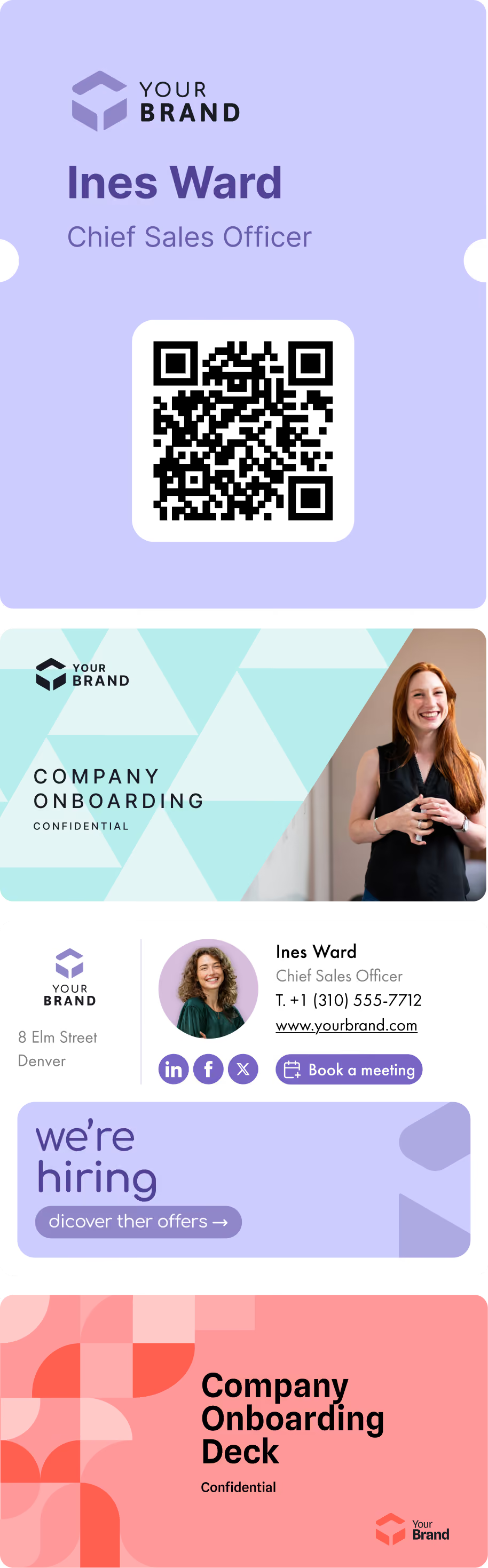
This means analyzing how the brand image is expressed, used, and perceived across every touchpoint. Scrutinize the materials produced by the different departments: email signatures, PowerPoint presentations created by sales teams, visuals on social media, and administrative documents.
This in-depth audit makes it possible to accurately measure the gap between the theoretical guidelines set out in your brand guidelines and actual day-to-day usage. By understanding these discrepancies, you will be able to identify your teams’ real needs in terms of support and tools.
Once the audit is complete, list the main areas of friction.
Inconsistencies are not merely aesthetic; they can create legal compliance issues or weaken the organization’s credibility. Is the logo frequently distorted? Is the tone being used too corporate compared with customer expectations?
Remember: fragmented, contradictory, or inconsistent messaging dilutes the strength of your positioning. By analyzing every aspect of your current governance, you can prioritize areas for action and quickly address any potential inconsistencies.
In the long term, identifying these risks makes it possible to build a governance strategy that actively protects the value of your intangible assets in the face of rapid market changes.
Do not try to govern through prohibitions: governance that is too rigid is often bypassed by teams looking for greater responsiveness...
Instead, focus on the key non-negotiable elements, such as logo usage, primary colors, and core values, while leaving room for creative freedom elsewhere. Bonus: by giving them some freedom to operate, your teams will be all the more invested!
The overarching goal should always be to ensure perfect alignment with the company’s strategic objectives. By defining best practices that are both clear and accessible, you provide a secure framework that encourages innovation rather than holding it back.
As mentioned above, clarity of roles is the driving force behind success.
It is therefore crucial to formally define exactly who does what within the organization. This can involve establishing a responsibility matrix to clarify governance processes and decision-making pathways.
For example, in large organizations, the board of directors or executive leadership should approve major strategic directions, while the brand manager oversees operational execution.
Defining these responsibilities helps prevent bottlenecks and ensures that every stakeholder, from creator to approver, understands the scope of their role in making the brand shine.
To encourage employees to adopt brand governance, you need to make things easier for them by bringing all resources together in one place.
Create a single point of access, such as a brand center, bringing together all the necessary resources: logos, templates, image libraries, and style guides. Transparency and accessibility are the pillars of internal engagement.
For example, effective centralization allows companies to dramatically reduce the time spent by the design studio answering repetitive questions. By providing ready-to-use tools, you encourage team autonomy while maintaining complete control over the quality of the content produced.
Brand governance is not a fixed project but an ongoing cycle.
It is essential to establish performance monitoring to assess the effectiveness of your rules and tools. Use regular analyses based on precise key performance indicators (KPIs) to determine whether overall consistency is improving.
Do not hesitate to adjust your governance models based on feedback from the field, technological developments, or new market trends.
After all, a living brand must be able to adapt to specific issues without losing its soul! This agility enables your management system to remain relevant and effective over the long term.
To move from theory to practice, several technology solutions are available:
One of the costliest mistakes is believing that the initial registration of a trademark is enough to protect it over the long term.
Effective governance must incorporate ongoing monitoring to detect registrations of similar names or unauthorized use by third parties. “Playing with fire” by ignoring prior-art searches or failing to monitor your trademark portfolio exposes the organization to costly legal disputes and a depreciation of its intangible assets.
To prevent these unfortunate situations, it is advisable to put rigorous monitoring in place, ideally centralized within a dedicated management system rather than relying on simple Excel files, as this is essential for ensuring legal compliance and the long-term protection of your assets.
A classic mistake? Designing governance exclusively for external customers... while forgetting that employees are the first brand ambassadors.
A lack of authenticity between the values being promoted and the experience actually lived internally can indeed create a profound misalignment. For example, if employees do not feel involved or if their well-being is neglected, the company culture deteriorates, directly affecting the quality of service and the perceived brand image.
Sound governance should foster a sense of belonging by actively engaging teams in the process of enhancing the brand, thereby ensuring complete consistency between marketing promises and the human reality behind them.
In the digital age, failing to integrate online reputation management into your governance strategy is a major mistake.
Ignoring customers’ voices on social media or review platforms, for example, can turn a minor incident into a genuine crisis. On this subject, take a look at our guide to effective crisis communication!
Transparency is now an expectation: a company that fails to respond professionally to criticism or lacks proactivity in monitoring its online reputation risks a sharp decline in its valuation. It is crucial to establish clear response protocols to turn every piece of feedback into an opportunity for improvement and protect the company’s integrity.
The fragmentation of information between departments (Marketing, IT, Legal, HR) is a common obstacle to achieving a comprehensive view.
When analyses and financial data are not shared or are not up to date, strategic decisions are made blindly. Modern governance must break down these silos and adopt a cross-functional approach. Without an integrated management system capable of cross-referencing brand performance indicators with operational realities, the company loses agility and relevance.
Centralization is not limited to logos; it also encompasses the strategic intelligence associated with the brand.
For organizations operating across multiple markets, the mistake is to try to impose absolute uniformity without taking cultural specificities into account.
A brand that is too rigid may appear disconnected from local expectations, while a brand that is too permissive loses its identity. The challenge of brand direction is to define guidelines that ensure global recognition while providing the flexibility needed to adapt to local market trends.
Failing to provide these areas for adaptation within your governance model can lead either to resistance among local teams or to a loss of relevance among end consumers.
*****
Did you know? According to a Lucidpress study, consistent brand presentation can increase revenue by 23%. Brand governance is therefore about much more than design: it is a strategic growth lever!
By structuring your processes and equipping your teams with the right tools, you transform your brand into a robust asset capable of weathering crises and entering new markets with complete clarity. Speaking of practical tools, discover Letsignit Slides, the solution that automatically integrates your brand guidelines into all your PowerPoint presentations!

An excellent example is a multinational company that uses a global brand center. Central teams define global campaigns, while local subsidiaries can translate slogans and adapt visuals (for example, changing the models featured in photos to better reflect the local culture) through locked templates. This ensures that the brand image remains the same everywhere while still being locally relevant.
There are generally two main governance models:
Governance and management are complementary but distinct. Governance establishes the framework, long-term objectives, and rules of the game (the “what” and the “why”). Management handles day-to-day execution, team leadership, and resource allocation in order to achieve these objectives (the “how”). In short, governance provides direction, while management handles execution.
The 5 C’s of branding could be Clarity, Consistency, Credibility, Connection, and Commitment. Together, they help a brand communicate a clear identity, build trust, create meaningful relationships with its audience, and maintain a strong, consistent presence over time.