.svg)


Life is short. So why spend valuable time adjusting your fonts, brand colors, and slide layouts every time you start a new project? The good news is that there’s a simple trick to avoid this repetitive, time-consuming work: create your own PowerPoint template and learn how to save it.
Instead of keeping your master presentation in .pptx format, you can save it as a PowerPoint template in .potx format. This file can then serve as the basis for new presentations without modifying the original template.
If you’d like to learn how to design your visuals from scratch before saving your template, check out our complete guide on how to create a PowerPoint template. Let’s take a look at how to save your creations and save time every day.
Saving a PowerPoint template only takes a few clicks in the desktop application (on both PC and Mac, as this feature isn’t available in PowerPoint for the web).
First, customize your document: you can adjust the background, change styles, or define a set of layouts using Slide Master under the View tab. You can also choose the standard landscape orientation or switch to portrait format under the Design tab.
To save your work, follow these steps:
As soon as you switch to the .potx format, PowerPoint automatically changes the storage location to the folder dedicated to templates. This makes it easy to find your work during future sessions!
It’s easy to confuse a template with a theme. However, these two elements serve very different purposes!
A template (.potx) encompasses an entire PowerPoint presentation, including pre-filled text boxes, image placeholders, footers, and specific layouts. A theme, on the other hand, focuses solely on the visual identity: the winning combination of colors, fonts, and graphic effects.
So, if you simply want to save the design of your PowerPoint presentation and apply it to any existing file without changing its content, a theme is ideal:
Once saved, your new theme will appear in the standard theme gallery. With a simple right-click, you can even set it as the default theme for all your future documents.
Once your template is safely stored on your computer, using it to start a new presentation couldn’t be easier. PowerPoint separates your custom creations from the default designs, allowing you to work more efficiently.
Here’s how to get started:
If you need to make any adjustments to your template, be sure to check out our guide on how to edit a PowerPoint template.
The location of your PowerPoint templates depends on your computer and configuration.
On Windows, personal templates are generally saved in Documents > Custom Office Templates. To access them, open File Explorer and go to your Documents folder. You should find the dedicated templates folder there.
Depending on your version of PowerPoint or your organization's settings, templates may also be stored in the Microsoft Office Templates folder, located within your Windows user files.
On Mac, PowerPoint generally stores templates in the Microsoft Office folder, which can be accessed through your user Library. Since this folder is hidden by default in macOS, it is often easier to find your templates directly in PowerPoint through the Personal templates section.
*****
You now know how to save a PowerPoint template and where to find your saved templates. T
o boost your efficiency by 1,000 points and ensure complete visual consistency, take a look at Letsignit Slides, which lets you automatically import your brand guidelines into all your new presentations.

Yes, with the 'Campaigns' offer, it is possible to track the number of clicks on the email signatures of all your employees in the 'Statistics' area of the platform.
You can then access a detailed or global view of the number of clicks on the email signatures of each employee. You can use the search option to target a specific signature or a given period. Finally, you have the possibility to export all statistics to an Excel document.
If you launch campaigns with banners inserted in your email signatures, you can also access their performance via this same space.
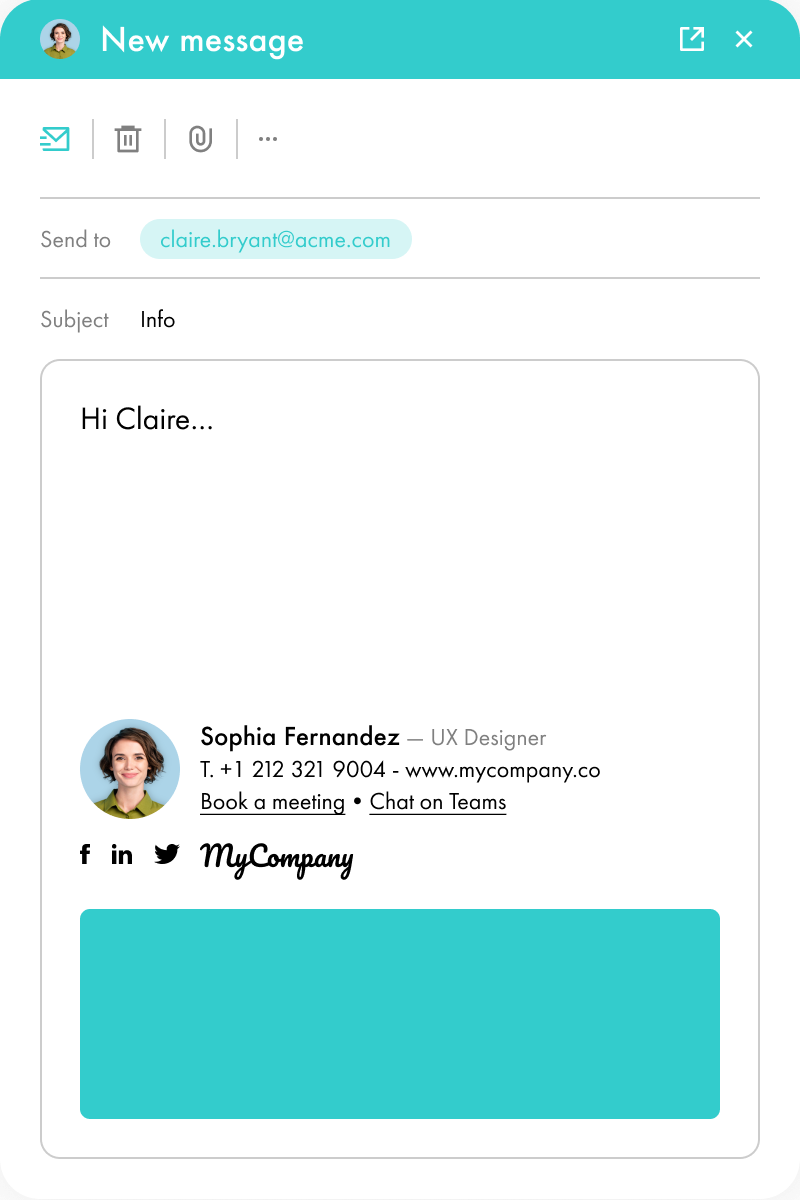
With Letsignit, you can easily add social network icons in your collaborators' email signatures and link to your company pages. Also, our "attributes" feature allows you to manage personalized URLs for each of your collaborators such as their individual LinkedIn profile.
And that's not all: you can add links to an appointment-setting application, allow your customers to leave reviews easily, and integrate our 'Chat on Teams' widget to let anyone start a discussion via Microsoft Teams chat.
It’s up to you! As an administrator of the Letsignit platform, you choose whether or not to grant modification rights to your employees. These permissions are managed on an attribute-by-attribute basis, which means that you can decide to allow the employee to change their phone number, but not the address of your premises, for example.
This feature applies to all attributes in your directory, including custom attributes created on Letsignit. When your employees change one or more attributes, your directory is obviously not affected.
It often happens that employees make their email signature their own: custom format, bad fonts, colors inconsistent with the brand standards... all of this has an impact on your brand!
A consistent visual identity is considered authentic and outperforms a perceived weak one by 20%. And, your customers are 2.4 times more likely to buy your products.
With Letsignit, take back control over your brand identity by standardizing all your email signatures. Our tool has many features that allow you to customize your signatures by department, by audience or by subsidiary. Not to mention the possibility of carrying out campaigns within your email signatures thanks to our Campaign offer.
What is the user experience like for our employees?
In both cases:
In short, they have autonomy in their email signature, but you keep control on the field, signatures, and banners they can edit or use.
With our "multi-signature" feature, your employees can benefit from multiple email signatures. No technical manipulation is required. Thanks to our Add-in for Outlook or the desktop app, they can change their email signatures as they wish with just a few clicks.
Regarding the creation of email signatures, you can make several variations such as:
Everything has been thought of to go further in the personalization process based on the recipient of your emails.
If sending emails has an impact, non-optimized email signatures also have an impact. An unsuitable format or an image that is too heavy considerably increases the size of your signatures... and therefore, your emails.
As a responsible economic actor, we contribute to reducing our CO2 emissions and those of our customers in several ways:
As we are increasingly involved in sustainability initiatives, our priority in 2023 is to develop even more green IT functionality.
If sending emails has an impact, non-optimized email signatures also have an impact. An unsuitable format or an image that is too heavy considerably increases the size of your signatures... and therefore, your emails.
As a responsible economic actor, we contribute to reducing our CO2 emissions and those of our customers in several ways:
As we are increasingly involved in sustainability initiatives, our priority in 2023 is to develop even more green IT functionality.
A PowerPoint template is a reusable presentation framework that defines the layout, colors, fonts, and graphic elements. To create one, customize your presentation or its Slide Master, then save it in PowerPoint Template (.potx) format.
To create a PowerPoint template, customize a presentation with your colors, fonts, layouts, and graphic elements. Then click File > Save As, choose PowerPoint Template (.potx) as the file format, and save the file.
To change the design of a presentation, open the Design tab. You can choose a theme, modify its variants, colors, and fonts, or customize the layout using Slide Master.
You can find free PowerPoint templates and themes on Microsoft’s template library, as well as on various websites offering downloadable presentation designs.
Go to the Design tab to change the theme, colors, fonts, or overall look of your presentation. To adjust individual slide layouts, use Home > Layout or customize them through View > Slide Master when creating a new presentation.
A PowerPoint template (.potx) includes the presentation’s design, layouts, placeholders, and other elements, while a theme (.thmx) mainly defines its visual style, including colors, fonts, and effects.


Lorem ipsum dolor sit amet, consectetur adipiscing elit, sed do eiusmod tempor incididunt ut labore et dolore magna aliqua. Ut enim ad minim veniam, quis nostrud exercitation ullamco laboris nisi ut aliquip ex ea commodo consequat. Duis aute irure dolor in reprehenderit in voluptate velit esse cillum dolore eu fugiat nulla pariatur.