

Branding
Published:
August 24, 2026
Updated:
August 24, 2026

Brand Guidelines: Definition, Benefits, and How to Create Them

By
Letsignit

Imagine for a moment that you walk into a bakery with a bright red sign, menus written in neon green in a Gothic font, and employees wearing electric blue aprons. You would probably feel a little confused, wouldn’t you?

That is exactly what happens to a company that communicates without a consistent visual thread. In the professional world, your visual identity is often the first point of contact with a prospect. Without visual consistency, however, that first message can quickly become unclear. This is where a document that is often dreaded but ultimately invaluable comes into play: brand guidelines!

Far more than a simple technical manual, brand guidelines are the visual soul of your project and the safeguard that ensures your brand can be recognized at a glance. This applies whether your brand is displayed on a huge billboard or on the small screen of a smartphone. Creating brand guidelines does not necessarily require you to be a design genius, but it does require a certain method and a clear vision of what you want to communicate to the world.

TL ; DR - Key Takeaways

  • Brand guidelines define your visual identity. They establish clear rules for your logo, colors, typography, imagery, and other visual elements.
  • Consistency builds recognition and trust. A unified look across every touchpoint makes your brand more memorable, professional, and credible.
  • They improve efficiency. Clear rules reduce mistakes, revisions, and ambiguity while making collaboration easier for internal teams and external partners.
  • Creating them starts with strategy. Define your brand values and personality, establish an art direction and moodboard, then design a simple, memorable, versatile, and timeless logo.
  • Keep the guidelines practical and accessible. Document logo usage, color codes, typography, and do’s/don’ts; tools like Canva, Adobe Express, and Figma can help maintain consistency.

What Are Brand Guidelines?

Brand Guidelines Definition

Brand guidelines are a little like the “genetic code” of your visual identity, formalized through a set of clear guidelines. This reference document brings together all the fundamental rules governing the use of the graphic elements that make up the identity of a company, brand, or even association.

They do not simply say, “Here is my logo!” They also explain how it should be used, displayed, and adapted across different media, both in internal communications and external communications.

What Do Brand Guidelines Include?

Brand guidelines are based on three essential elements:

  1. The logo: brand guidelines define its proportions, variations (colors, black and white, and simplified versions for social media), and, above all, its “clear space,” the empty space around it that allows it to remain legible.
  2. The color palette: here, we are not simply talking about “blue” or “red,” but about precise references such as HEX, RGB, or CMYK codes. Each shade is chosen to evoke a specific emotion: for example, blue for trust, orange for energy, or black for luxury.
  3. Typography: the choice of typefaces is crucial because it directly influences how your message is perceived. A serif font, for example, will convey tradition and seriousness, while a sans-serif font will appear more modern and approachable.

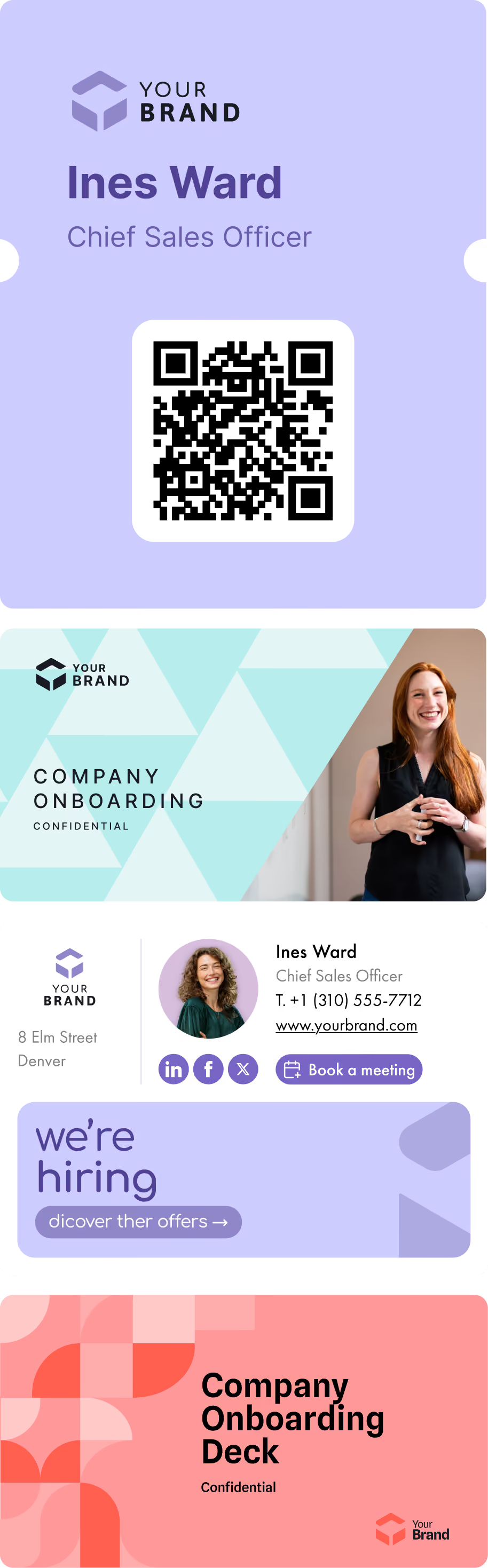
In addition to these elements, brand guidelines can include rules regarding iconography, the style of photographs to use, and secondary graphic elements such as patterns or divider lines. The result is a cohesive visual system that creates a unique brand universe across all your communication channels, from email signatures to email banners, as well as your website.

Why Are Brand Guidelines Important?

Do you think brand guidelines are a luxury reserved for multinational companies? Think again! Not only are they important for all types of businesses, but they are even more crucial for smaller organizations looking to stand out.

Create a Consistent Visual Identity

Remember: on a typical day, the same customer may be exposed to different elements of your communication. For example, they might see your invoice in the morning, a professional email signature from one of your employees in the afternoon, and your logo on Instagram in the evening.

However, if these different touchpoints use different colors or styles, the customer may not necessarily make the connection between them. Brand guidelines ensure that your brand communicates through one consistent visual identity, helping strengthen brand recognition and memorability.

Improve Efficiency and Reduce Errors

Brand guidelines are also a valuable working tool that helps guide graphic designers and other creative professionals.

Without clear guidelines, a freelance graphic designer may need numerous explanations, scattered files, and several rounds of revisions before achieving the expected result. With brand guidelines, however, they immediately have the rules to follow and all the information they need to do their best work.

This can deliver multiple productivity benefits:

  • fewer errors;
  • fewer approximations;
  • faster production;
  • better collaboration between teams.

By the way, did you know that some tools are specifically designed to help you maintain visual brand consistency across your communications? Letsignit Slides, for example, automatically incorporates your brand guidelines into all your PowerPoint presentations.

Build Trust With a Strong Brand Identity

With a well-defined visual identity supported by your brand guidelines, you are much more likely to make a strong first impression.

Your prospect or customer will see a company that knows who it is and understands its strengths. It is also a sign of professionalism and evidence of your attention to detail. All of these elements can encourage your audience to place their trust in your brand.

Furthermore, by defining your own visual rules, you retain control over your brand image and lay the foundations for consistent, long-term communication. This is particularly important during key communication moments, such as a corporate PowerPoint presentation.

How to Create General Brand Guidelines

Eager to create your brand guidelines? Before getting down to the practical side of things by launching your design software, you first need to go through a strategic thinking phase!

Define Your Brand Identity

The first essential step is to clarify your company’s values and personality.

Remember: your brand guidelines are a direct expression of your brand DNA. This introspective process helps establish a moral and conceptual identity that will serve as the foundation for every future creative choice, from the shade of blue you select to the shape and style of your chosen typeface.

To successfully complete this branding exercise, ask yourself the following fundamental questions:

  • What message and mission do you want to communicate? Think about your company’s ambitions and the position you hold in your market compared with your competitors.
  • If your brand were a person, how would it dress and what tone of voice would it use? Identify precise adjectives (dynamic, corporate, disruptive, elegant, approachable) to define the contours of this personality.
  • What are your brand’s core values? Whether they involve innovation, sustainability, proximity, or luxury, these principles should shine through in every visual element to evoke the desired emotion in your target audience.

An excellent way to refine this vision is to work through opposites: identify the values that contradict your brand so you can immediately eliminate graphic codes that do not reflect who you are.

Develop Your Brand’s Art Direction

Once the strategic foundations have been established, it is time to let your creativity speak and bring your ideas to life! This transition phase between the abstract concept and visual reality is often referred to as defining the art direction.

The goal is to identify the visual styles that fit your project by exploring and bringing together a wide range of sources of inspiration, including:

  • inspiring images (photographs, illustrations, icons);
  • textures and materials (textured paper, brushed metal, transparency effects);
  • harmonious color palettes (by testing contrasts and complementary combinations);
  • varied graphic references (magazine layouts, web interface styles, posters).

Be careful: the goal is not to copy what already exists, but rather to develop a coherent and unique visual direction.

To achieve this, creating a moodboard is just as essential as it is stimulating! This visual tool allows you to bring together the best of your selected visuals on a single page and assess how well they work together.

It is a valuable tool for defining the project’s art direction and sharing it with your colleagues or clients. The idea is to make sure everyone is on the same page, for example when designing your PowerPoint templates or any other communication material.

By incorporating examples of typefaces and HEX codes at this stage, you begin to bring the atmosphere of your future visual identity to life. The moodboard acts as a guide to help you stay on track throughout the production process.

Design a Versatile Logo

The next step is designing your logo! If it has not yet been created or needs to be redesigned, now is the time to give it your full attention. As the cornerstone of your visual identity, your logo is often the first physical or digital point of contact between your brand and its audience. You must therefore ensure that it accurately reflects your brand’s identity while also being immediately recognizable.

To ensure the long-term effectiveness of your brand identity, a good logo should meet several fundamental criteria:

  • Simple: clarity is the key to memorability. Focus on the essentials and avoid unnecessary embellishments, overly complex gradients, or details that disappear at small sizes. Clean design means your message can be understood instantly!
  • Memorable: it should have a unique character that allows it to make a lasting impression on your audience. The goal is for your prospect to remember your logo just a few seconds after seeing it.
  • Flexible and adaptable: this is a key criterion for maintaining the consistency of your brand guidelines. Your logo should be designed to retain its full visual impact whether it appears on a small item such as a pen or a favicon, on your social media profiles, or in a large format on a truck or billboard.
  • Timeless: while it should feel modern, it should also avoid following overly short-lived trends so that it does not look dated after just a few months!

Also remember to plan for different logo variations during the design phase: a monochrome version for low-cost printing, an inverted version for dark backgrounds, and potentially a simplified version (or standalone icon) adapted to the square or circular format constraints of digital avatars.

Document Your Brand Guidelines

The final step is to document all the rules governing your visual identity. This document will help ensure consistency in your communications over time by serving as a guide for all your employees, whether in-house or freelance!

When creating your brand guidelines, define the following elements:

  • No more than two or three typefaces.
  • A primary color palette.
  • A few accent colors.
  • The different logo versions and how they should be used.

For each element, specify best practices and mistakes to avoid. For example, clearly state that the logo should never be stretched, have its original colors altered, or be placed on a background that compromises its legibility.

It is simple: the more precise your brand guidelines are, the easier it will be for your employees, partners, or service providers to follow your visual identity without room for interpretation.

What Software Can You Use to Create Brand Guidelines?

You can hardly wait any longer: it is time to roll up your sleeves and get to work! To get started, here is a selection of effective, simple, and even free software tools for quickly creating brand guidelines.

Canva: A Simple and Efficient Design Tool

There is no doubt about it: Canva is one of the most popular graphic design tools among entrepreneurs, freelancers, and small businesses.

Its Brand Kit features allow you, for example, to centralize:

  • A company’s logos in their different versions.
  • The colors selected for its brand guidelines.
  • The typefaces used by the brand.

You can then instantly apply these elements to all your internal communication tools and external communications, including social media posts, presentations, and commercial documents. Its main advantage? Sim-pli-ci-ty: just a few clicks are enough to achieve a professional result!

Adobe Express: Creative Design Made Simple

Need more possibilities to let your creativity fully express itself? Adobe Express may be the solution you are looking for. It is an excellent alternative for those who want greater creative freedom without technical complexity.

The tool combines:

  • The quality of the Adobe ecosystem.
  • A quick learning curve.
  • An intuitive interface.

On Adobe Express, you will find many customizable templates, and creating visuals that are consistent with your brand identity is very straightforward. It is an interesting solution for benefiting from the Adobe ecosystem without having to master more advanced software such as Illustrator or InDesign.

Figma: The Ideal Tool for Collaborative Design

Calling all those who work in teams! For web- or digital-focused projects, or simply to make collaborative tasks easier, Figma is particularly relevant.

Originally designed for interface design, this software also makes it easy to create and share graphic systems among several team members. Colors, typefaces, visual components, and usage guidelines can all be brought together in the same space, accessible to your entire team.

It is an excellent choice for organizations that want to evolve their visual identity collaboratively while keeping their brand documentation up to date.

*****

Brand guidelines are much more than a reference document! They are a true foundation for your company’s visual identity, ensuring its consistency and impact across every communication channel. Take the time to define them to build a compelling and memorable brand presence.

About the author
About Letsignit
Letsignit is an email signature management solution that empowers organizations to turn employee email signatures into a dynamic and personalized engagement channel for their brands and campaigns.

Questions
Fréquentes

1

Is it possible to track the number of clicks on email signatures?

Yes, with the 'Campaigns' offer, it is possible to track the number of clicks on the email signatures of all your employees in the 'Statistics' area of the platform.

You can then access a detailed or global view of the number of clicks on the email signatures of each employee. You can use the search option to target a specific signature or a given period. Finally, you have the possibility to export all statistics to an Excel document.

If you launch campaigns with banners inserted in your email signatures, you can also access their performance via this same space.

2

Can we add links to social networks, our website, and appointment-setting applications such as Calendly?

With Letsignit, you can easily add social network icons in your collaborators' email signatures and link to your company pages. Also, our "attributes" feature allows you to manage personalized URLs for each of your collaborators such as their individual LinkedIn profile.

And that's not all: you can add links to an appointment-setting application, allow your customers to leave reviews easily, and integrate our 'Chat on Teams' widget to let anyone start a discussion via Microsoft Teams chat.

3

Can employees update their signature information themselves (number, function, etc.)?

It’s up to you! As an administrator of the Letsignit platform, you choose whether or not to grant modification rights to your employees. These permissions are managed on an attribute-by-attribute basis, which means that you can decide to allow the employee to change their phone number, but not the address of your premises, for example.

This feature applies to all attributes in your directory, including custom attributes created on Letsignit. When your employees change one or more attributes, your directory is obviously not affected.

4

Why it is important to standardize our email signatures on a large scale to ensure our identity and brand image?

It often happens that employees make their email signature their own: custom format, bad fonts, colors inconsistent with the brand standards... all of this has an impact on your brand!

A consistent visual identity is considered authentic and outperforms a perceived weak one by 20%. And, your customers are 2.4 times more likely to buy your products.

With Letsignit, take back control over your brand identity by standardizing all your email signatures. Our tool has many features that allow you to customize your signatures by department, by audience or by subsidiary. Not to mention the possibility of carrying out campaigns within your email signatures thanks to our Campaign offer.

5

What is the user experience like for our employees?

What is the user experience like for our employees?

  • If you opt for the Letsignit Add-in for Outlook, they will have a dedicated space in their Outlook account where they will be able to view the signatures and campaigns assigned to them.
  • If you opt for the Letsignit Desktop APP, they will be able to preview all their signatures and campaigns in this space. If they want to change their default signature to another one when sending an email, this will be done in their signature library in Outlook.

In both cases:

  • They preview their signature before sending an email and choose from signatures assigned to them.
  • Based on the permissions granted, they will also be able to modify their personal information such as their name, position, or address in these spaces.

In short, they have autonomy in their email signature, but you keep control on the field, signatures, and banners they can edit or use.

6

Can my employees have multiple signatures available to them?

With our "multi-signature" feature, your employees can benefit from multiple email signatures. No technical manipulation is required. Thanks to our Add-in for Outlook or the desktop app, they can change their email signatures as they wish with just a few clicks.

Regarding the creation of email signatures, you can make several variations such as:

Everything has been thought of to go further in the personalization process based on the recipient of your emails.

7

Regarding “Green IT,” have you implemented measures to limit the digital footprint of email signatures?

If sending emails has an impact, non-optimized email signatures also have an impact. An unsuitable format or an image that is too heavy considerably increases the size of your signatures... and therefore, your emails.

As a responsible economic actor, we contribute to reducing our CO2 emissions and those of our customers in several ways:

  • Optimization of the weight of signatures and campaigns in emails.
  • Green features: lightening of signatures during response/transfer emails, possibility of not embedding images, implementation of lighter signatures for internal exchanges.
  • Integration of a 'Switch to Teams' widget to encourage your employees to continue their exchanges via chat, rather than email.

As we are increasingly involved in sustainability initiatives, our priority in 2023 is to develop even more green IT functionality.

8

Regarding “Green IT,” have you implemented measures to limit the digital footprint of email signatures?

If sending emails has an impact, non-optimized email signatures also have an impact. An unsuitable format or an image that is too heavy considerably increases the size of your signatures... and therefore, your emails.

As a responsible economic actor, we contribute to reducing our CO2 emissions and those of our customers in several ways:

  • Optimization of the weight of signatures and campaigns in emails.
  • Green features: lightening of signatures during response/transfer emails, possibility of not embedding images, implementation of lighter signatures for internal exchanges.
  • Integration of a 'Switch to Teams' widget to encourage your employees to continue their exchanges via chat, rather than email.

As we are increasingly involved in sustainability initiatives, our priority in 2023 is to develop even more green IT functionality.

Frequently asked questions

1

How Do I Write Brand Guidelines?

Start by defining your brand’s logo, color palette, typography, imagery, and tone of voice. Then, document clear rules and examples explaining how each element should be used across your communications.

2

Where Can I Find Brand Guidelines Examples And Templates?

You can find brand guidelines examples and templates on platforms such as Behance, Dribbble, and Pinterest. These resources can help you structure your own guidelines and find inspiration for your visual identity.

3

How To Create Brand Guidelines With AI? 

AI tools can help you define your color palette, choose complementary fonts, generate moodboards, and structure your brand guidelines. Start by providing your brand values, target audience, and visual preferences, then refine the generated guidelines to match your brand identity.
4

5

6

7
8

Looking for a tool to manage your email signatures?

Letsignit allows you to create, manage, and deploy email signatures for all your employees in just a few clicks.
Discover Letsignit