
Advice
Published:
October 22, 2025
Updated:
September 24, 2026

How to Create a Professional Email Address With Gmail

By
Letsignit

Gone are the days of school email addresses, when the biggest concern was whether ricky3000@aol.com or jane.lol@hotmail.com would actually make us look cool... Nowadays, your email address is much more than a simple contact detail: it is an essential part of your professional identity.

It is first and foremost a cornerstone of consistent, professional communication. But it also gives you access to a complete email and productivity environment designed to help you work more efficiently, whether you're a solo entrepreneur or part of a growing team.

Today, we're taking a closer look at professional Gmail addresses: why you might want one, and, most importantly, how to set one up in just a few steps.

What’s the Difference Between a Free Gmail Address and a Professional Email Address?

At first glance, Google's now-familiar email provider's interface looks much the same whether you're using a personal or business account. You still get the streamlined inbox, useful labels, powerful search, and familiar Gmail interface.

But behind the scenes, a free personal Gmail account and a Google Workspace business account are designed for very different purposes.

Using a Free Gmail Address for Your Business

When you're launching a new business, it can be tempting to stick with the simplicity of a free Gmail address ending in @gmail.com. After all, it's quick to create, costs nothing, and can be perfectly adequate while you're getting your business off the ground.

However, a generic Gmail address can become less appropriate as your business grows.

For example, sending a proposal from johnsmithmarketing@gmail.com may look less established than sending it from johnsmith@marketing.com. A custom domain gives customers and prospects an immediate indication that you're operating under an established business identity.

There are practical limitations, too. A personal Google Account comes with 15 GB of storage shared across Gmail, Google Drive, and Google Photos. It also doesn't give you the centralized administration, user management, and business-oriented controls available with Google Workspace.

Using Gmail with a Custom Professional Email Address

Google Workspace lets you use Gmail with your own business domain, turning the familiar Gmail interface into a professional business email system.

Instead of communicating from yourbusiness@gmail.com, you can use a custom address such as firstname@yourbusiness.com. 

That small difference can make your communications look much more consistent and professional.

Google Workspace also adds business-oriented features for teams, including pooled storage, centralized account management, collaboration tools, security controls, and administrative features. 

How to Choose the Right Professional Email Address

Choosing the right professional email address isn't just about making it look good. A clear, predictable address is easier for customers to remember and reduces the likelihood of typos or messages being sent to the wrong person.

Which Email Address Format Should You Choose?

The golden rule is simple: keep it professional, predictable, and easy to type.

There are several common formats, and the right choice depends on the size of your organization, your brand identity, and how you expect your team to grow.

Some of the most popular formats include:

  • firstname@company.com: simple, personal, and easy to remember. This format works particularly well for freelancers, consultants, founders, and small teams.
  • firstname.lastname@company.com: the classic corporate format. It works particularly well for medium-sized and larger organizations and helps distinguish employees with the same first name.
  • initial.lastname@company.com (such as j.smith@company.com): a shorter alternative often used by larger organizations where keeping addresses concise is important.

Why Use Your Own Domain Name?

Think of your domain name as the foundation of your company's digital identity.

Every email you send using that domain reinforces your brand. Instead of simply communicating through a generic email provider, you're consistently putting your company name in front of customers, prospects, suppliers, and partners.

A custom domain also gives you greater independence. If you eventually change your website hosting provider, email software, or other business tools, you can generally keep the same domain and email addresses.

Your domain also gives you control over email authentication. Technologies such as SPF, DKIM, and DMARC can help protect your domain from spoofing and improve your email deliverability.

Common Mistakes to Avoid

To maintain a professional image and make your business communications as effective as possible, avoid these common mistakes when choosing and configuring your email address:

  • Keeping unnecessary numbers or old nicknames: leave birthdays, graduation years, ZIP codes, and teenage usernames out of your business email. Addresses such as sarah1987@gmail.com or cooldude@... may be fine for personal use, but they can make business communications look less polished.
  • Using confusing special characters or overly complicated addresses: avoid unnecessary punctuation, underscores, and long combinations of names. The more complicated an address is, the more likely someone is to mistype it.
  • Choosing an obscure or unclear username: creativity is great for your brand or visual identity, but your email address should generally make it obvious who you are. A straightforward name-based address is usually easier for customers and colleagues to understand.
  • Ignoring shared business inboxes: creating aliases or collective addresses such as contact@company.com, sales@company.com, or support@company.com can make it easier to manage customer communications. However, they should have clear ownership and someone responsible for monitoring incoming messages.

Create a Professional Gmail Address in 5 Steps

So, ready to take the plunge? Setting up your new professional environment with Google Workspace is easy if you follow these step-by-step instructions.

1-Choose a Google Workspace plan

  • Go to the official Google Workspace website and click Start Free Trial (or Get Started, depending on the offers currently available).
  • On the sign-up page, enter your company name in the appropriate field, select the size of your organization from the drop-down menu (from “Just you” to more than 300 employees), and select your country of operation. Then click Next.
  • Enter your personal details (first name, last name, and current email address), which will be used as the technical contact for setting up your customer account, then click Next again.

2-Choose or connect your domain name

  • Google will ask whether your organization already has a domain:
    => If you already have a website or a registered domain, click Yes, I have one I can use, enter your domain name (without the “www,” for example, mycompany.com), then click Next.
    => If you're starting from scratch, select No, I need to buy one to search for your desired domain name, check its annual cost, and purchase it directly through Google's domain registration partner.
  • Confirm your selection by clicking Next to officially link the domain name to your Google Workspace infrastructure.

3-Create your administrator account

  • Enter the username that will make up the part before the @ symbol in your primary email address (for example, your first name or firstname.lastname).
  • Set a strong password combining lowercase and uppercase letters, numbers, and symbols to secure access.
  • Check the I'm not a robot security box and click Agree and Continue to create your administrator credentials.
  • Keep these credentials somewhere safe: they will give you access to the Google Workspace Admin console, where you can manage the accounts for your entire organization.

4-Configure your settings

  • Sign in to the Google Workspace Admin console (admin.google.com) using the credentials you just created.
  • If you're working as part of a team, go to the side menu, click Directory, then Users, and select Add a new user to create individual email addresses for your partners or employees.
  • To keep your organization's environment consistent, go to Account, then Account settings, and click Personalization to upload your official brand logo.
  • Finally, adjust your organizational preferences (the suite's default language and time zone) by opening the Company profile section.

5-Verify your domain name

  • Log in to your domain provider (OVHcloud, Hostinger, GoDaddy, Gandi, etc.) and open the DNS Zone or DNS Management section.
  • In Google Workspace, choose TXT record verification and copy the verification code. Add it as a TXT record in your DNS settings, using @ as the host if required.
  • Then configure your MX record as instructed by Google Workspace. Remove any MX records from your previous email provider to avoid conflicts.
  • Return to Google Workspace and click Activate Gmail or complete the setup. DNS changes may take up to 72 hours to propagate.

Your professional Gmail address is now ready to use!

How to Create a Professional Gmail Address for Free

If you're launching a business or running a very small operation, you may understandably want to create a professional-looking email address without adding another monthly expense.

So, can you do that with Gmail?

The short answer is: yes, but there is an important distinction between a free Gmail address and a free custom-domain business email address.

Creating a Free Gmail Address

You can create a free Google Account with a Gmail address and use it exclusively for your business.

You can create the account through Google's standard account creation process and use Gmail, Google Drive, Calendar, and other Google services without paying for Google Workspace.

This can be a perfectly reasonable starting point for a freelancer or very early-stage business.

However, your address will still end in @gmail.com. You cannot simply turn a free Gmail account into you@yourbusiness.com without using a business email service such as Google Workspace.

Can You Get a Free Email Address With Your Own Domain?

This is where things become more complicated.

If you already have a custom-domain email address hosted by another provider, you may previously have been able to use Gmail's web interface to retrieve messages from that account or send messages using the third-party address.

However Google is currently phasing out those features.

Starting in January 2027, Gmail will discontinue web support for fetching third-party email through POP, Gmailify, and the ability to use the web or Gmail mobile apps to send mail from third-party email accounts through Gmail's “Send as” feature. Google Workspace and Gmail-hosted aliases are not affected. 

If you want to keep using a custom-domain address without Google Workspace, the simplest option is generally to use your email hosting provider's own webmail or app, or a compatible desktop email client.

In other words, a custom business email address can be inexpensive or even included with some hosting plans, but a free Gmail account does not provide free custom-domain email hosting.

How Much Does a Professional Gmail Address Cost?

The cost depends on whether you simply want a free @gmail.com address or a custom-domain address hosted through Google Workspace.

For a business using Gmail with its own domain, Google Workspace charges per user.

Google Workspace Pricing

As of September 2026, Google's US pricing page lists the following standard flexible-plan prices:

  • Business Starter: $7 per user per month. It includes 30 GB of pooled storage per user and a custom business email address.
  • Business Standard: $14 per user per month. It includes 2 TB of pooled storage per user and additional productivity and collaboration features.
  • Business Plus: $22 per user per month. It includes 5 TB of pooled storage per user and additional security and compliance features.
  • Enterprise: custom pricing for larger organizations requiring advanced security, administration, compliance, and support capabilities.

Google states that Business Starter, Business Standard, and Business Plus are available for organizations with up to 300 users, while Enterprise plans do not have the same 300-user limit.

Important: Google Workspace pricing varies by country, billing plan, and promotional offers. The prices above are US prices at the time of writing and should be treated as a reference rather than a permanent price list. Check Google's official pricing page before purchasing.

Which Google Workspace Plan Should You Choose?

For a freelancer, consultant, solopreneur, or very small business that mainly needs professional email and standard productivity tools, Business Starter may provide everything you need.

Business Standard becomes more relevant if your team regularly works with large files or needs substantially more pooled storage and additional collaboration features.

Business Plus adds further storage and security capabilities and may be relevant to organizations with more demanding compliance or data-management requirements.

The right choice ultimately depends on how many people need accounts, how much storage your organization uses, and which administrative or security features you require.

What Features Does Professional Gmail Offer?

Beyond branded email addresses and basic features such as creating Gmail rules, Google's professional email solution offers a powerful ecosystem of collaboration tools:

  • Business-focused security: Gmail includes spam and malware protection, while Google Workspace also provides administrative security controls and support for features such as two-step verification.
  • Integration with Google tools: Gmail works closely with Google Calendar, Google Drive, Google Meet, Docs, Sheets, and other Workspace applications. You can schedule meetings, share documents, and collaborate without constantly switching between unrelated platforms.
  • AI-powered features: Google Workspace increasingly integrates Gemini features across Gmail and other Workspace applications. Depending on your plan and current availability, these features can help summarize conversations, draft or refine emails, and assist with other productivity tasks. Google's current plans differ in which Gemini features they include. GGoogle Workspace
  • Aliases and delegation: you can create additional addresses and delegate access to certain mailboxes without giving employees access to someone else's personal password.

How to Manage Multiple Business Email Addresses with Gmail

Running a dynamic business often means segmenting your information flows, for example, sales inquiries, billing, support, or partnership communications. Google's email service gives you the flexibility to organize all of this.

Create Multiple User Accounts

Every employee joining your organization can have their own independent inbox. From the Admin console, simply add a new user and assign them their own password and individual email address, as described above.

Note that each Gmail user account you create has its own storage allocation and requires a separate paid license as part of your overall subscription.

Create a Gmail Alias

An alias is a favorite trick among entrepreneurs who want to appear more organized without spending an extra cent. It is a virtual address directly linked to your main account:

  • Go to the Admin console and open the profile of the relevant user.
  • Add a secondary address, such as contact@company.com or billing@company.com.
  • All messages sent to these aliases will then automatically arrive in your main inbox, and you can reply using the same identity at no additional cost.

Create an Address for Each Department

If your company has several departments, you can set up group addresses (for example, support@, sales@, hr@). These shared addresses instantly distribute incoming messages to the inboxes of designated team members.


This approach has several advantages, including reducing the risk of duplicate responses and ensuring continuity of communication even when colleagues are traveling or on vacation. And speaking of seamless communication, do you know how to enable Gmail sync so you can access your emails wherever you are?

Use Gmail Rules/Filters

To avoid becoming overwhelmed when managing multiple streams or addresses from the same inbox, automation becomes your best ally. With sorting rules, also known as Gmail filters, you can organize your messages (almost) without lifting a finger:

  • Access filter creation: click the search options icon (the sliders located to the right of the main search bar), or go through the Settings gear icon and open the Filters and Blocked Addresses tab.
  • Define your filtering criteria: target incoming emails based on the sender, recipient address (particularly your aliases or group addresses), specific keywords, or the presence of attachments.
  • Automate your actions: click Create a filter to choose what should happen to matching messages. You can automatically apply a colored label (for example, “Quotes,” “Support,” or “Urgent”), archive the message to keep it out of your main inbox, add a star for follow-up, or forward it to a team member.

This quick setup helps prevent important messages from getting lost while making your day-to-day email management more efficient.

Professional Gmail Email Address Examples

To help you choose a professional format, here are some examples based on the size and structure of your business.

For a Freelancer or Solopreneur

When you work alone, simplicity and personality are usually more important than creating a complex corporate naming system.

  • firstname@yourdomain.com (e.g. thomas@thomasdesign.com): simple, memorable, and ideal for building a personal connection with clients.
  • contact@yourdomain.com (used as an alias): useful on your website, business cards, and marketing materials when you want a general contact address without publishing your personal inbox.

For a Small Business

For a small business or startup with a handful of employees, consistency becomes more important.

  • firstname.lastname@company.com (e.g. claire.martin@atelierwood.com): a straightforward format that works well for employees and business partners.
  • sales@company.com or hello@company.com: useful shared or alias addresses for handling new inquiries and directing prospects to the right people.

For a Large Company

For larger organizations, standardization helps maintain consistency as the number of employees grows.

  • initial.lastname@company.com or firstname.lastname@company.com (e.g. m-bernard@logisticsgroup.com): standardized formats make it easier to manage large employee directories and distinguish people with similar names.
  • customer-service@company.com, recruitment@company.com: dedicated group addresses can be managed by teams rather than tied to a single employee, helping ensure that customer and candidate inquiries don't depend on one person's availability.

*****

As you can see, a professional Gmail email address can be a valuable part of your company's digital identity. And with Google Workspace, setting up Gmail with your own domain is relatively straightforward once you've chosen your domain and plan. 

And if you want to make every email look more professional, check out our guide on how to add an email signature in Gmail.

About the author
About Letsignit
Letsignit is an email signature management solution that empowers organizations to turn employee email signatures into a dynamic and personalized engagement channel for their brands and campaigns.

Questions
Fréquentes

1

Is it possible to track the number of clicks on email signatures?

Yes, with the 'Campaigns' offer, it is possible to track the number of clicks on the email signatures of all your employees in the 'Statistics' area of the platform.

You can then access a detailed or global view of the number of clicks on the email signatures of each employee. You can use the search option to target a specific signature or a given period. Finally, you have the possibility to export all statistics to an Excel document.

If you launch campaigns with banners inserted in your email signatures, you can also access their performance via this same space.

2

Can we add links to social networks, our website, and appointment-setting applications such as Calendly?

With Letsignit, you can easily add social network icons in your collaborators' email signatures and link to your company pages. Also, our "attributes" feature allows you to manage personalized URLs for each of your collaborators such as their individual LinkedIn profile.

And that's not all: you can add links to an appointment-setting application, allow your customers to leave reviews easily, and integrate our 'Chat on Teams' widget to let anyone start a discussion via Microsoft Teams chat.

3

Can employees update their signature information themselves (number, function, etc.)?

It’s up to you! As an administrator of the Letsignit platform, you choose whether or not to grant modification rights to your employees. These permissions are managed on an attribute-by-attribute basis, which means that you can decide to allow the employee to change their phone number, but not the address of your premises, for example.

This feature applies to all attributes in your directory, including custom attributes created on Letsignit. When your employees change one or more attributes, your directory is obviously not affected.

4

Why it is important to standardize our email signatures on a large scale to ensure our identity and brand image?

It often happens that employees make their email signature their own: custom format, bad fonts, colors inconsistent with the brand standards... all of this has an impact on your brand!

A consistent visual identity is considered authentic and outperforms a perceived weak one by 20%. And, your customers are 2.4 times more likely to buy your products.

With Letsignit, take back control over your brand identity by standardizing all your email signatures. Our tool has many features that allow you to customize your signatures by department, by audience or by subsidiary. Not to mention the possibility of carrying out campaigns within your email signatures thanks to our Campaign offer.

5

What is the user experience like for our employees?

What is the user experience like for our employees?

  • If you opt for the Letsignit Add-in for Outlook, they will have a dedicated space in their Outlook account where they will be able to view the signatures and campaigns assigned to them.
  • If you opt for the Letsignit Desktop APP, they will be able to preview all their signatures and campaigns in this space. If they want to change their default signature to another one when sending an email, this will be done in their signature library in Outlook.

In both cases:

  • They preview their signature before sending an email and choose from signatures assigned to them.
  • Based on the permissions granted, they will also be able to modify their personal information such as their name, position, or address in these spaces.

In short, they have autonomy in their email signature, but you keep control on the field, signatures, and banners they can edit or use.

6

Can my employees have multiple signatures available to them?

With our "multi-signature" feature, your employees can benefit from multiple email signatures. No technical manipulation is required. Thanks to our Add-in for Outlook or the desktop app, they can change their email signatures as they wish with just a few clicks.

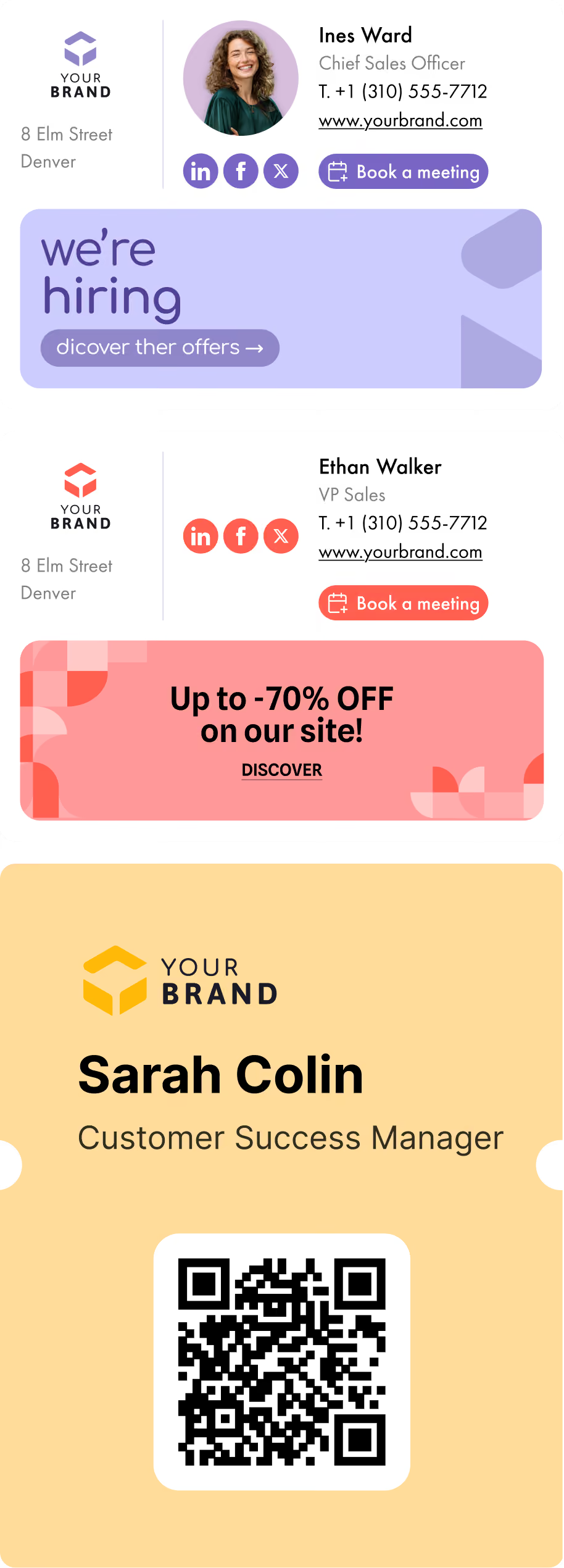
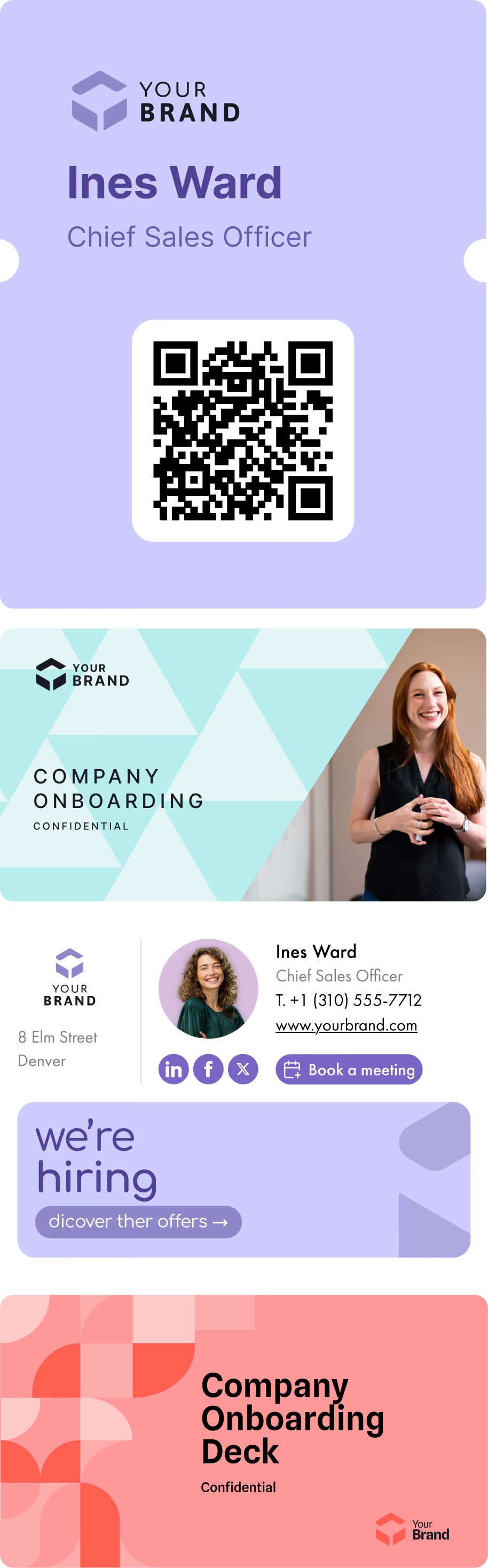
Regarding the creation of email signatures, you can make several variations such as:

Everything has been thought of to go further in the personalization process based on the recipient of your emails.

7

Regarding “Green IT,” have you implemented measures to limit the digital footprint of email signatures?

If sending emails has an impact, non-optimized email signatures also have an impact. An unsuitable format or an image that is too heavy considerably increases the size of your signatures... and therefore, your emails.

As a responsible economic actor, we contribute to reducing our CO2 emissions and those of our customers in several ways:

  • Optimization of the weight of signatures and campaigns in emails.
  • Green features: lightening of signatures during response/transfer emails, possibility of not embedding images, implementation of lighter signatures for internal exchanges.
  • Integration of a 'Switch to Teams' widget to encourage your employees to continue their exchanges via chat, rather than email.

As we are increasingly involved in sustainability initiatives, our priority in 2023 is to develop even more green IT functionality.

8

Regarding “Green IT,” have you implemented measures to limit the digital footprint of email signatures?

If sending emails has an impact, non-optimized email signatures also have an impact. An unsuitable format or an image that is too heavy considerably increases the size of your signatures... and therefore, your emails.

As a responsible economic actor, we contribute to reducing our CO2 emissions and those of our customers in several ways:

  • Optimization of the weight of signatures and campaigns in emails.
  • Green features: lightening of signatures during response/transfer emails, possibility of not embedding images, implementation of lighter signatures for internal exchanges.
  • Integration of a 'Switch to Teams' widget to encourage your employees to continue their exchanges via chat, rather than email.

As we are increasingly involved in sustainability initiatives, our priority in 2023 is to develop even more green IT functionality.

Frequently asked questions

1

Can Gmail Be Used As a Professional Email Address? 

Yes, Gmail can be used professionally, especially through Google Workspace, which lets you use a custom business domain and access Gmail along with other business tools.

2

What Is a Good Professional Gmail Address? 

A good professional address is simple, clear, and easy to remember, typically using your first name, last name, or both (for example, firstname.lastname@company.com).

3

How Do I Get a Custom Email Domain and Use It With Gmail?

Sign up for Google Workspace, purchase a domain or connect one you already own, verify the domain through your DNS settings, and activate Gmail to start sending and receiving emails from your custom address.
4

5

6

7
8

Looking for a tool to manage your email signatures?

Letsignit allows you to create, manage, and deploy email signatures for all your employees in just a few clicks.
Discover Letsignit