

Branding
Published:
Updated:
July 31, 2026

Employer Brand: Definition, Challenges, and Tips for Developing It

By
Letsignit

The tide has turned and the balance of power has shifted: candidates looking for their future company are no longer satisfied with a salary alone, they are seeking a project, values, and an authentic work experience.

That is why, today, working on your employer brand is as essential as eating five fruits and vegetables a day or doing 30 minutes of daily physical activity: it is a matter of the health and longevity of the organization! However, this is not something that can be done in the blink of an eye. It requires learning how to cultivate your core identity in order to attract top talent and turn every employee into a driver of influence and visibility.

This is an approach that requires a global reflection, involving everyone from top management to HR teams, in order to align external promises with the reality experienced internally. Here are our best tips for developing your employer brand.

TL;DR - Key Takeaways

  • An employer brand reflects a company’s image, values, and the real employee experience.
  • A strong employer brand helps attract top talent and improve employee retention.
  • It is built on three pillars: employer identity, employee experience, and authentic communication.
  • To strengthen it, audit your current brand, define your EVP, empower employees as ambassadors, create engaging content, and track your results.
  • Avoid making unrealistic promises: consistency between what you say and what employees experience is the key to a credible employer brand.

What Does The Term “Employer Brand” Mean?

Definition

Concretely, the employer brand refers to the image, reputation, and attractiveness of an organization among its current employees and potential applicants. Unlike traditional corporate communication, it focuses exclusively on the human and social dimension of the company.

The employer brand is based on a principle of absolute consistency: what you claim as an employer must be a perfect reflection of what your employees experience on a daily basis. In short, it is the reflection of your DNA, your management practices, and your company culture in your real operational environment.

The Different Aspects Of The Employer Brand

To properly understand this concept, it is essential to distinguish the different dimensions that make up the employer brand. It is not limited to the image projected by the company, but is based on three complementary pillars:

  • Employer identity: what the company truly is. It includes its culture, values, vision, compensation policy, as well as all the elements that shape the employee experience.
  • Internal employer image: the perception employees have of their organization. It is built through their daily experience, their quality of life at work, and their sense of belonging.
  • External employer image: how applicants, former employees, and the general public perceive the company. It is influenced, among other things, by HR communication, online reviews, social media, and employee testimonials.

Once again, for an employer brand to be credible and effective, everything is about consistency: these three dimensions must be aligned for truly effective recruitment marketing. A gap between external promises and internal reality can quickly damage the organization’s attractiveness and reputation.

What Is The Purpose Of An Employer Brand For A Company?

The development of an employer brand pursues several objectives, but if only one were to be retained, it would be this: creating a lasting relationship of trust between the organization and its talent.

Remember: in a context where a majority of companies report recruitment difficulties, a strong employer brand acts as a true magnet. It helps stand out in the “talent war” thanks to a clear and differentiating value proposition.

What Are The 3 Components Of A Strong Employer Brand?

Employer Identity: Values, Culture, And Promise

Everything begins with a phase of introspection. Employer identity corresponds to what your company fundamentally is: its history, mission, values, and Employee Value Proposition (EVP).

It answers a key question:

Why would a talent choose to join your company rather than another, and more importantly, choose to stay there?

This identity must be clear, fully embraced, and differentiated in order to attract talent most likely to thrive within the organization.

It is based in particular on:

  • Your vision and purpose
  • Your values as they are truly lived on a daily basis
  • Your management culture
  • Your employer promise (EVP)

Experience: From Recruitment To The Employee Journey

Beyond nice speeches, the employer brand is proven in practice at every stage of the employee journey and throughout the actual experience within the organization.

It begins from the very first contact with a candidate and continues well beyond hiring. This is a global experience that includes:

  • The quality and transparency of the recruitment process
  • The smoothness and care of onboarding
  • Daily working conditions
  • Work-life balance
  • Training and career development opportunities
  • The quality of management and internal relationships

As you know, a positive and consistent experience strengthens employee engagement, motivation, and retention. Conversely, a gap between promise and reality can quickly weaken trust.

Remember: the most successful organizations are those that place people at the heart of their HR strategy by creating a stimulating, evolving work environment aligned with the current expectations of talent.

Employer Communication: Building An Attractive Image

Employer communication consists of giving visibility to what the company actually experiences internally.

It should not aim to beautify reality, but rather make it readable, attractive, and authentic. This communication relies on several channels, such as:

  • Social media
  • The career website
  • Recruitment campaigns
  • Employee testimonials
  • Employer brand content (videos, articles, podcasts, etc.)

Effective communication is largely based on storytelling: it tells the story of the organization, the real experiences of its members, and highlights employee career paths. All of this helps applicantsd project themselves into the company.

How To Build And Enhance Your Employer Brand: A 5-Step Action Plan

1. Start With An Employer Brand Audit And Diagnosis

Before launching any communication campaign, it is essential to carry out an honest assessment. This diagnosis is based on internal satisfaction surveys, qualitative interviews, and analysis of external feedback (Google reviews, Glassdoor, social media comments and reactions).

The goal is to understand any gap between management perception and the reality experienced by teams. This audit then helps identify both the strengths to build on and the friction points to fix.

2. Define Your Identity And Value Proposition (EVP)

Once the diagnosis is complete, you must formalize your employer identity. What concrete benefits do you offer? What is your management culture?

Your EVP must be the guiding thread of all HR actions. It must be strong enough to attract top talents, but realistic enough to be delivered. At this stage, you define your personas (typical candidate profiles) in order to tailor your messaging to their specific expectations.

3. Turn Your Employees Into Your Best Ambassadors

Nothing is more powerful than social proof: you should therefore encourage your teams to speak up. After all, your employees are your best ambassadors because their voice is perceived as far more credible than that of a recruiter.

By implementing an Employee Advocacy program, you enable employees to share their daily experiences on LinkedIn or Twitter, naturally increasing the reach of your employer brand without additional advertising costs.

4. Deploy A Consistent Content And Media Strategy

Your brand must be visible where your candidates are. This includes an optimized career site, carefully written job offers, and an active presence on social media.

Use a variety of formats: “a day in the life” videos, employee podcasts, or blog articles about your management innovations. Also ensure visual and editorial consistency across all content to build a strong and recognizable brand image.

5. Continuously Monitor, Measure, And Adjust

Think of employer branding as a living process in constant evolution. To evaluate its effectiveness, you must track key performance indicators (KPIs): retention rate, cost per hire, quality of applications, eNPS (Employee Net Promoter Score).

Agility is essential: if internal feedback shows a drop in satisfaction on a specific topic (such as training or quality of work life), you must be able to quickly adjust your action plan to stay aligned with your promise.

Tools And Channels To Activate Your Employer Brand

To amplify your employer identity, several tools and channels are available. Used correctly, they strengthen your visibility, consistency, and attractiveness to talent.

The career website remains the cornerstone of any employer branding strategy. As the first point of contact between candidates and your company, it must be mobile-friendly, fast, clear, and above all rich in authentic content: employee testimonials, job descriptions, company values, and insights into daily team life. The more immersive it is, the more it helps candidates project themselves.

Professional social networks such as LinkedIn are also essential. They play a key role in sourcing and distributing high-value content. Articles, employee posts, behind-the-scenes content, and HR news all help build a more human and engaging employer image.

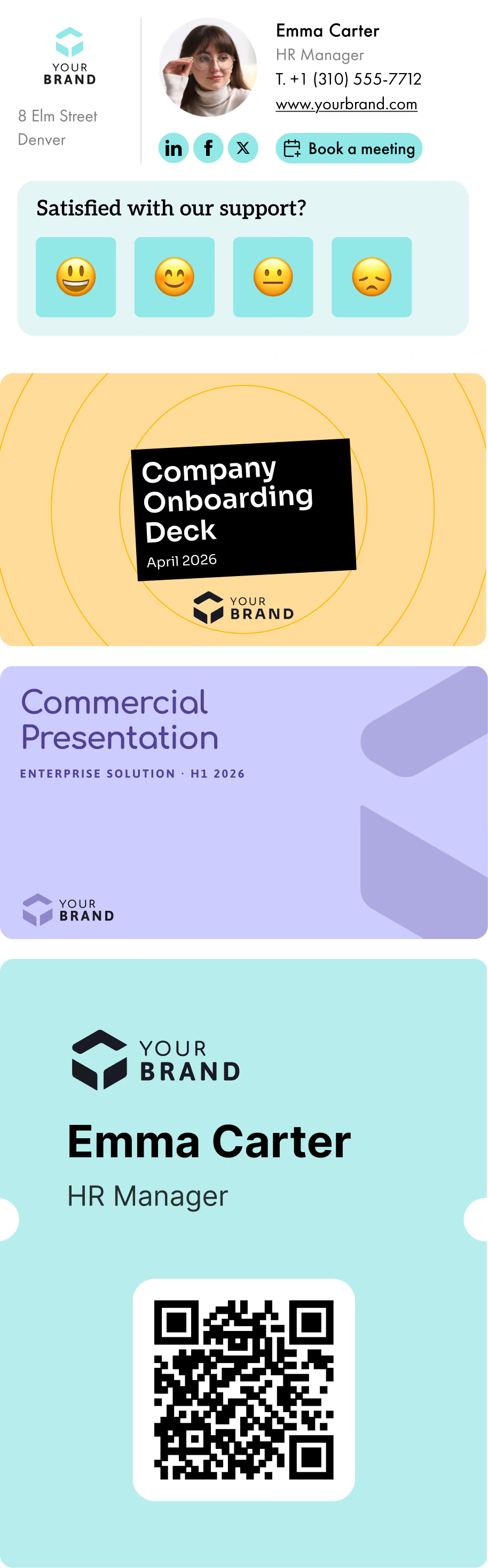
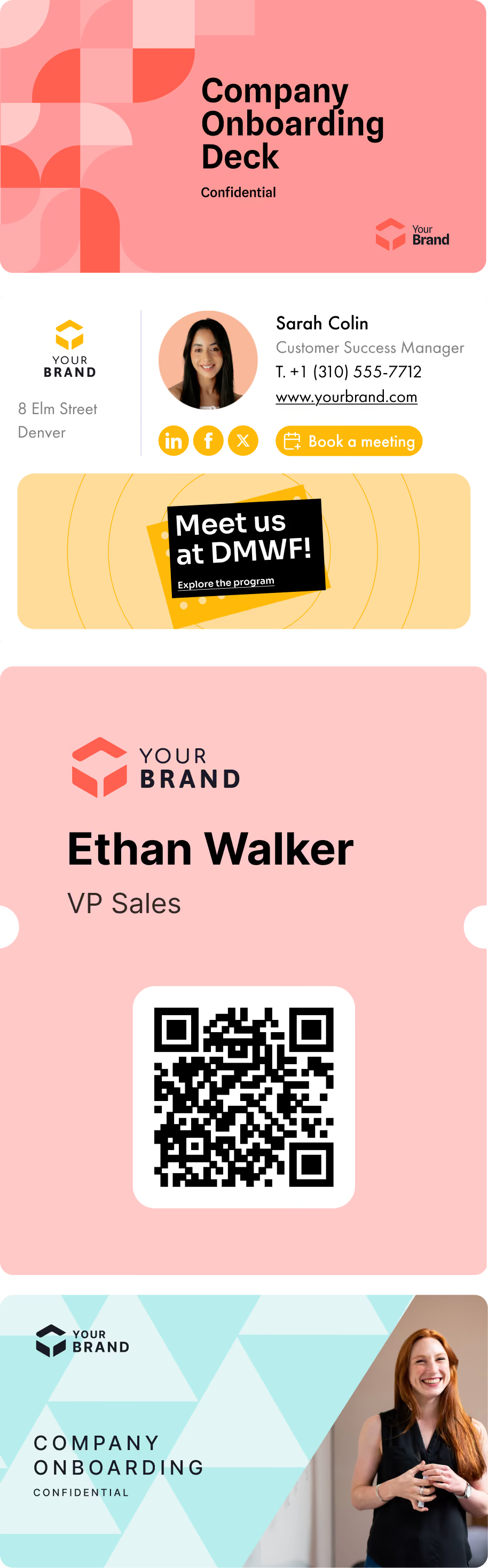
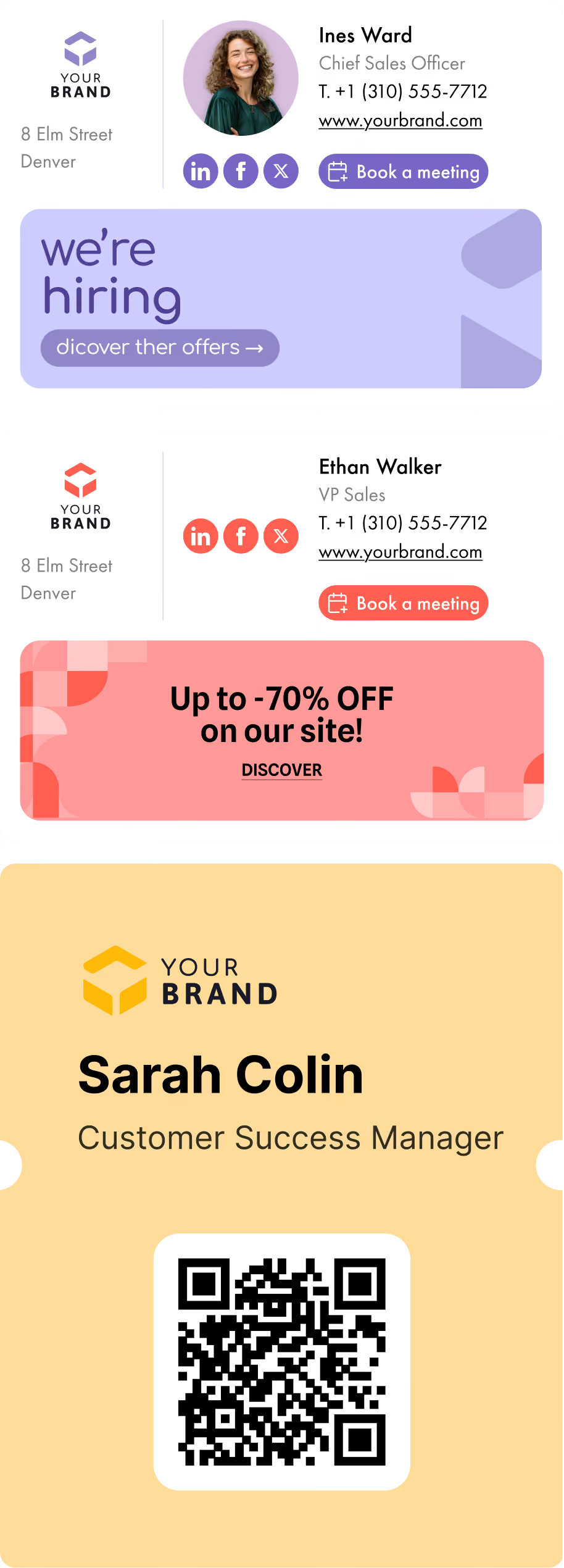
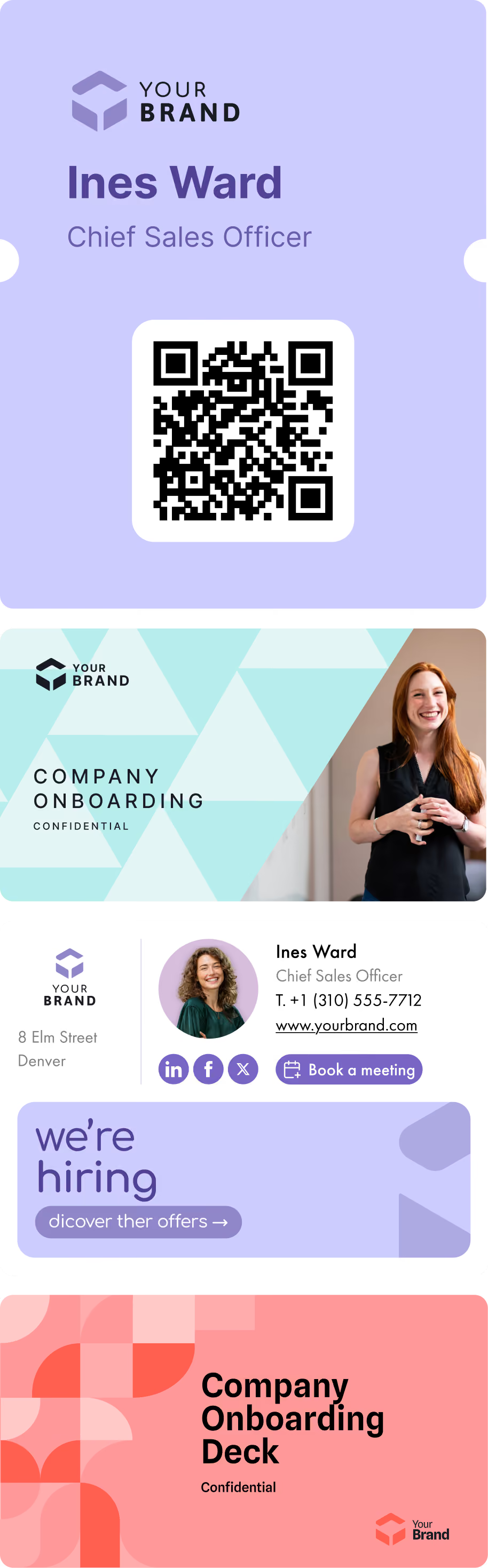
Finally, one often underestimated but extremely powerful tool is the email signature. Every employee sends dozens of emails per day to partners, clients, or potential candidates. Using a recruitment-focused signature allows you to distribute job openings or HR updates in a non-intrusive and professional way.

5 Mistakes To Avoid To Protect Your Reputation

  • Overpromising and embellishing reality: this is the main risk. If candidates notice a gap between interview messaging and real working conditions, they will quickly leave, generating high turnover costs.
  • Neglecting candidate experience: a slow process or lack of feedback after interviews can turn a candidate into a critic. Every interaction matters, even if it does not result in a hire.
  • Focusing only on external communication: employer branding starts with current employees. If internal experience is neglected, your external communication will feel inauthentic.
  • Failing to tailor your strategy: a small business does not communicate like a large corporation, just as a startup does not communicate like a decades-old company. Your strategy must fit your size and industry.
  • Not involving management: managers are the primary day-to-day drivers of employer branding. If they are not trained or involved, the promise will never be delivered.

*****

Taking care of your employer brand means both creating the right conditions to attract top talent and ensuring long-lasting, successful collaborations within your organization. So it is time to act: start now by analyzing your current situation and identifying your first areas for improvement.

About the author
About Letsignit
Letsignit is an email signature management solution that empowers organizations to turn employee email signatures into a dynamic and personalized engagement channel for their brands and campaigns.

Questions
Fréquentes

1

Is it possible to track the number of clicks on email signatures?

Yes, with the 'Campaigns' offer, it is possible to track the number of clicks on the email signatures of all your employees in the 'Statistics' area of the platform.

You can then access a detailed or global view of the number of clicks on the email signatures of each employee. You can use the search option to target a specific signature or a given period. Finally, you have the possibility to export all statistics to an Excel document.

If you launch campaigns with banners inserted in your email signatures, you can also access their performance via this same space.

2

Can we add links to social networks, our website, and appointment-setting applications such as Calendly?

With Letsignit, you can easily add social network icons in your collaborators' email signatures and link to your company pages. Also, our "attributes" feature allows you to manage personalized URLs for each of your collaborators such as their individual LinkedIn profile.

And that's not all: you can add links to an appointment-setting application, allow your customers to leave reviews easily, and integrate our 'Chat on Teams' widget to let anyone start a discussion via Microsoft Teams chat.

3

Can employees update their signature information themselves (number, function, etc.)?

It’s up to you! As an administrator of the Letsignit platform, you choose whether or not to grant modification rights to your employees. These permissions are managed on an attribute-by-attribute basis, which means that you can decide to allow the employee to change their phone number, but not the address of your premises, for example.

This feature applies to all attributes in your directory, including custom attributes created on Letsignit. When your employees change one or more attributes, your directory is obviously not affected.

4

Why it is important to standardize our email signatures on a large scale to ensure our identity and brand image?

It often happens that employees make their email signature their own: custom format, bad fonts, colors inconsistent with the brand standards... all of this has an impact on your brand!

A consistent visual identity is considered authentic and outperforms a perceived weak one by 20%. And, your customers are 2.4 times more likely to buy your products.

With Letsignit, take back control over your brand identity by standardizing all your email signatures. Our tool has many features that allow you to customize your signatures by department, by audience or by subsidiary. Not to mention the possibility of carrying out campaigns within your email signatures thanks to our Campaign offer.

5

What is the user experience like for our employees?

What is the user experience like for our employees?

  • If you opt for the Letsignit Add-in for Outlook, they will have a dedicated space in their Outlook account where they will be able to view the signatures and campaigns assigned to them.
  • If you opt for the Letsignit Desktop APP, they will be able to preview all their signatures and campaigns in this space. If they want to change their default signature to another one when sending an email, this will be done in their signature library in Outlook.

In both cases:

  • They preview their signature before sending an email and choose from signatures assigned to them.
  • Based on the permissions granted, they will also be able to modify their personal information such as their name, position, or address in these spaces.

In short, they have autonomy in their email signature, but you keep control on the field, signatures, and banners they can edit or use.

6

Can my employees have multiple signatures available to them?

With our "multi-signature" feature, your employees can benefit from multiple email signatures. No technical manipulation is required. Thanks to our Add-in for Outlook or the desktop app, they can change their email signatures as they wish with just a few clicks.

Regarding the creation of email signatures, you can make several variations such as:

Everything has been thought of to go further in the personalization process based on the recipient of your emails.

7

Regarding “Green IT,” have you implemented measures to limit the digital footprint of email signatures?

If sending emails has an impact, non-optimized email signatures also have an impact. An unsuitable format or an image that is too heavy considerably increases the size of your signatures... and therefore, your emails.

As a responsible economic actor, we contribute to reducing our CO2 emissions and those of our customers in several ways:

  • Optimization of the weight of signatures and campaigns in emails.
  • Green features: lightening of signatures during response/transfer emails, possibility of not embedding images, implementation of lighter signatures for internal exchanges.
  • Integration of a 'Switch to Teams' widget to encourage your employees to continue their exchanges via chat, rather than email.

As we are increasingly involved in sustainability initiatives, our priority in 2023 is to develop even more green IT functionality.

8

Regarding “Green IT,” have you implemented measures to limit the digital footprint of email signatures?

If sending emails has an impact, non-optimized email signatures also have an impact. An unsuitable format or an image that is too heavy considerably increases the size of your signatures... and therefore, your emails.

As a responsible economic actor, we contribute to reducing our CO2 emissions and those of our customers in several ways:

  • Optimization of the weight of signatures and campaigns in emails.
  • Green features: lightening of signatures during response/transfer emails, possibility of not embedding images, implementation of lighter signatures for internal exchanges.
  • Integration of a 'Switch to Teams' widget to encourage your employees to continue their exchanges via chat, rather than email.

As we are increasingly involved in sustainability initiatives, our priority in 2023 is to develop even more green IT functionality.

Frequently asked questions

1

What Is The Definition of Employer or Recruitment Branding? 

Employer branding (or recruitment branding) is the way a company is perceived as an employer by employees, candidates, and the public. It covers reputation, culture, employee experience, and HR communication, and aims to attract and retain talent beyond salary alone.

2

What Are The 4 P's Of Employer Branding? 

  • Promise: What the company commits to offering employees
  • People: Employees and their lived experience
  • Positioning: How the company stands out as an employer
  • Proposition: The Employee Value Proposition (EVP)

And remember, employer branding is reflected in every interaction. Even everyday communications—such as knowing how to write a formal email—help reinforce your company's professional image and candidate experience.

3

What Is the Difference Between EVP and Employer Branding? 

The EVP is the core offer, in other words what the company gives employees to better employee experience. Employer branding is how that offer is communicated, experienced, and perceived internally and externally.

4

How Do You Measure The Success Of Strategic Employer Branding?

Success is measured through key indicators such as eNPS, retention rate, time to hire, quality of applications, cost per hire, and candidate/employee satisfaction.

5

Can You Work With An Employer Branding Agency?

Yes, especially for audit and diagnostic phases or for the creation of complex communication campaigns. An external perspective often helps identify strengths that are no longer visible internally.
6

7
8

Looking for a tool to manage your email signatures?

Letsignit allows you to create, manage, and deploy email signatures for all your employees in just a few clicks.
Discover Letsignit