.svg)


The days when candidates discovered a company during a job interview—or even on their first day—are long gone. Today, job seekers research employers well before they apply. Social media, career websites, employee reviews, and conversations with friends and professional contacts all give candidates valuable insights into a company long before they ever step through its doors.
This is where employer branding comes into play. Companies now have to contend with better-informed candidates, increasingly mobile career paths, and changing expectations. Candidates are looking for more than just a job: they want a certain work environment, shared values, and a culture they can identify with.
For today’s organizations, building a strong employer brand has therefore become essential. But how can you make your company more attractive—and, more importantly, turn that attractiveness into qualified applications?
In a world where candidates have become genuine pre-recruitment Sherlock Holmes, your employer brand acts as a first filter: it can make someone want to learn more or, conversely, encourage them to move on. But that’s not all.
There are several reasons why companies should invest in their employer brand:
Whatever your strategy, effective brand governance is essential to strengthening your organization’s visibility and impact.
An attractive employer brand can influence several stages of the candidate journey.
First, it helps increase a company’s visibility among potential candidates. Regular communication about careers, teams, and projects allows an organization to build awareness even before a recruitment need arises.
It also helps candidates picture themselves working for the company. Employee testimonials, content about different roles, and a clear presentation of company culture give candidates a better understanding of the working environment they can expect.
Third, a consistent employer brand can help build stronger, longer-lasting relationships with candidates. Even when someone is not hired, their experience with the company can influence how they perceive the organization in the future—and what they tell the people around them. Employer branding therefore matters even when a candidate is unsuccessful: the goal should always be to leave a positive impression.
Finally, because a strong employer brand can help reduce employee turnover, it may indirectly reduce the need for repeated recruitment campaigns—and therefore the resources required to run them. In other words, effective employer branding can save your company time, money, and energy.
An effective recruitment marketing and branding strategy rests on four complementary pillars.
Have you ever been disappointed by a brand promise? Think of that supposedly unstoppable vacuum cleaner that gives up after three cleaning sessions... Employer branding needs to avoid falling into the same trap.
A company’s DNA, values, ways of working, and everyday practices should be reflected in the messages it communicates to candidates. For example, if an organization presents itself as highly flexible while employees actually have very little freedom in their day-to-day work, the disconnect will eventually become apparent.
One important point: authenticity does not mean that a company has to be perfect. It simply means presenting a reality that is recognizable, credible, and genuinely embraced by the organization.
Attractiveness is a company’s ability to make people want to join it and picture themselves as part of the organization. It can come from the roles on offer, career development opportunities, training, working conditions, employee benefits, as well as the company’s values and commitments.
A strong employer brand is primarily about standing out from other employers and highlighting what genuinely meets candidates’ expectations. The goal is not necessarily to appeal to everyone, but rather to help the right candidates see themselves in the organization—and want to join it.
By the way, when it comes to developing your brand and highlighting what makes you attractive, it can all start with a customized PowerPoint template.
What a company claims to offer should be something its employees actually experience. Put simply, a credible employer brand is built on a genuine employee experience.
Onboarding, working conditions, career development opportunities, recognition, and many other factors all shape that experience. From recruitment to onboarding and throughout an employee’s career, every stage can influence how people perceive their employer.
Managers play a particularly important role here. The way they support their teams, communicate, listen, and recognize good work has a direct impact on employee well-being and engagement. It is a responsibility that deserves to be taken seriously.
Building a positive employer brand is important—but if nobody sees it, it will not have the desired impact. To attract top talent, a company also needs to know how to communicate its identity and what makes it distinctive.
Employer branding can—and should—be developed and shared across multiple channels: social media, career websites, events, editorial content, and everyday communications, for example. These channels make it possible to show candidates what the company genuinely has to offer and reach them where they naturally look for information.
Employees can also play an important role in increasing employer brand visibility. When they share their day-to-day experiences, achievements, or professional journeys, they bring a human dimension to the company and make its messaging feel more authentic. On the other side of the screen, prospective candidates get a glimpse of what the company is really like and can more easily picture themselves working there.
Before trying to attract new talent, take the time to identify what makes your company different.
Why did your employees choose to join you? Why do they stay? What characterizes your company culture? Which aspects of everyday working life do they genuinely appreciate? The answers can come from internal surveys, interviews, HR data, or conversations with teams.
This process helps uncover what truly defines your employer brand rather than simply reproducing the arguments used by your competitors. It is an opportunity to identify and document your unique strengths, specific areas for improvement, values, and, more broadly, everything that makes the employee experience within your company distinctive.
Your company does not need to claim to be exceptional in every area. It simply needs to understand what makes it unique in order to build a solid foundation for its employer brand.
Once you have identified your differentiators, you need to know how to articulate them.
Your employer value proposition (EVP) should answer one simple question: Why would a talented professional choose your company over another?
The answer might involve your culture, the work itself, training opportunities, the working environment, your CSR, or career prospects.
The goal is not to pile up benefits, but to highlight a clear, credible promise that is consistent with your company’s DNA. For example, almost every digital company now offers competitive salaries and modern offices. To stand out, a company in this sector might instead emphasize the opportunity to work on genuinely innovative and groundbreaking projects.
Once your employer value proposition has been defined, it can guide your job descriptions, career-site content, and all communications aimed at candidates.
A polished corporate promise is not always enough to convince a candidate. Nothing beats real-life experience.
The third way to strengthen your employer brand is to give your employees a voice—the people who experience your company every day.
A testimonial about a particular role, a typical working day, a career journey, or a project can provide much more depth than generic corporate messaging. Employees can also share their experiences on social media, take part in events, or contribute to HR content.
Do not be afraid to move beyond traditional formats. A podcast, for example, or short, engaging videos on your YouTube channel can make employee stories more accessible and engaging. All candidates have to do is press play.
A company can attract candidates with compelling messaging, but it will only retain its talent if reality lives up to the promise.
If you highlight flexible working hours, they genuinely need to be flexible. If you promote training opportunities, employees need to be able to access them. If you emphasize autonomy, employees need to have genuine decision-making power.
In short, consistency between what you say and what employees experience is essential.
It is also what allows an employer brand to remain strong over the long term. Candidates may forget a communication campaign, but a positive or negative experience is likely to leave a much more lasting impression.
Your employer brand needs to be visible before potential candidates even consider applying.
The key is to build a positive and consistent image through carefully selected channels—the ones naturally used by the talent you want to reach.
For example, a company looking to recruit recent graduates might prioritize LinkedIn, Instagram, relationships with universities and colleges, and student events. A company targeting highly specialized professionals, on the other hand, might focus more on industry-specific content, professional events, or employee testimonials.
Like any strategy, employer branding needs to evolve based on regular feedback.
To determine whether your actions are working, you can track several metrics: the number of applications, candidate quality, job-offer conversion rates, career-site traffic, engagement with HR content, and offer acceptance rates, among others.
You should also make use of internal feedback by regularly asking new hires and established employees for their views. As an integral part of your organization, their perspective can help you identify what is working, what could be improved, and how your employer brand can continue to evolve.
Employer brand management is not the responsibility of a single department. HR, communications, managers, and leadership teams all have a role to play.
If we had to narrow it down to just three tips for effectively managing your employer brand, they would be:
An overly ambitious employer promise may generate applications, but it can also create disappointment if it is not backed up by concrete, long-term action.
It is better to highlight a few benefits that genuinely set you apart than to make a long list of promises you cannot keep.
Employer branding is not just about future candidates. It also applies to current employees, former employees, partners, and the wider public—and it extends well beyond the recruitment process.
Reducing employer branding to the job interview means overlooking a large part of the experience that shapes your company’s reputation.
A strategy designed solely from an HR perspective can easily overlook what really makes a difference.
Employees know what works, what could be improved, and what makes them want to stay. Their feedback should therefore inform your thinking throughout the entire process of developing and improving your employer brand.
A company can communicate about its values, commitments, and practices—but if everyday reality tells a different story, candidates and employees will notice.
All employer brand communications should therefore be aligned with the actual employee experience.
Without clear metrics, it is difficult to know whether your employer branding efforts are genuinely improving your attractiveness as an employer.
Tracking applications, engagement, content visibility, and candidate perceptions can help identify the most effective levers and refine your strategy over time.
Flexibility is key when it comes to improving your employer brand!
Best practices can sometimes be easier to understand when they are brought to life by real companies. To inspire you, here are three real-world examples of employer brands that have made a genuine impact.
Patagonia has built a strong employer brand around its environmental mission and values. Rather than treating purpose as a marketing message, the company has made it an important part of its employee experience and company culture.
Its commitment to environmental activism, responsible business practices, and work-life balance helps attract people who share these values. This alignment between what Patagonia stands for and what employees experience is a powerful example of authentic employer branding.
Salesforce has developed an employer brand strongly associated with its company values, particularly trust, customer success, innovation, and equality.
The company regularly highlights employee stories, career development opportunities, and its workplace culture to give prospective candidates a glimpse into life at Salesforce. By putting its people at the center of its communications, Salesforce turns its employees into an important part of its employer brand.
LEGO has built an employer brand that reflects one of its most recognizable characteristics: creativity.
The company emphasizes a culture where employees are encouraged to experiment, collaborate, and bring new ideas to life. Its employer communications also showcase the people and teams behind the LEGO brand, helping candidates understand what it is actually like to work there.
The result is a strong connection between the consumer brand and the employer brand: the creativity and playfulness associated with LEGO are also reflected in the company’s approach to its employees.
*****
For an employer brand to remain effective over time, it cannot be reduced to attractive messaging or a handful of well-promoted benefits. Instead, it needs to be built into everyday working life, through the experience employees actually have and the way the company shares that experience with future talent.
So, before trying to attract the best candidates, start by asking yourself one simple question: What genuinely makes people want to work for your company?
Once you have the answer, all that remains is to tell the story—and, most importantly, to make it a reality.
Want consistent communication from A to Z to maximize your chances of attracting the right candidates? Turn to Letsignit Slides, which ensures your brand guidelines are applied consistently across all your PowerPoint presentations.

Yes, with the 'Campaigns' offer, it is possible to track the number of clicks on the email signatures of all your employees in the 'Statistics' area of the platform.
You can then access a detailed or global view of the number of clicks on the email signatures of each employee. You can use the search option to target a specific signature or a given period. Finally, you have the possibility to export all statistics to an Excel document.
If you launch campaigns with banners inserted in your email signatures, you can also access their performance via this same space.
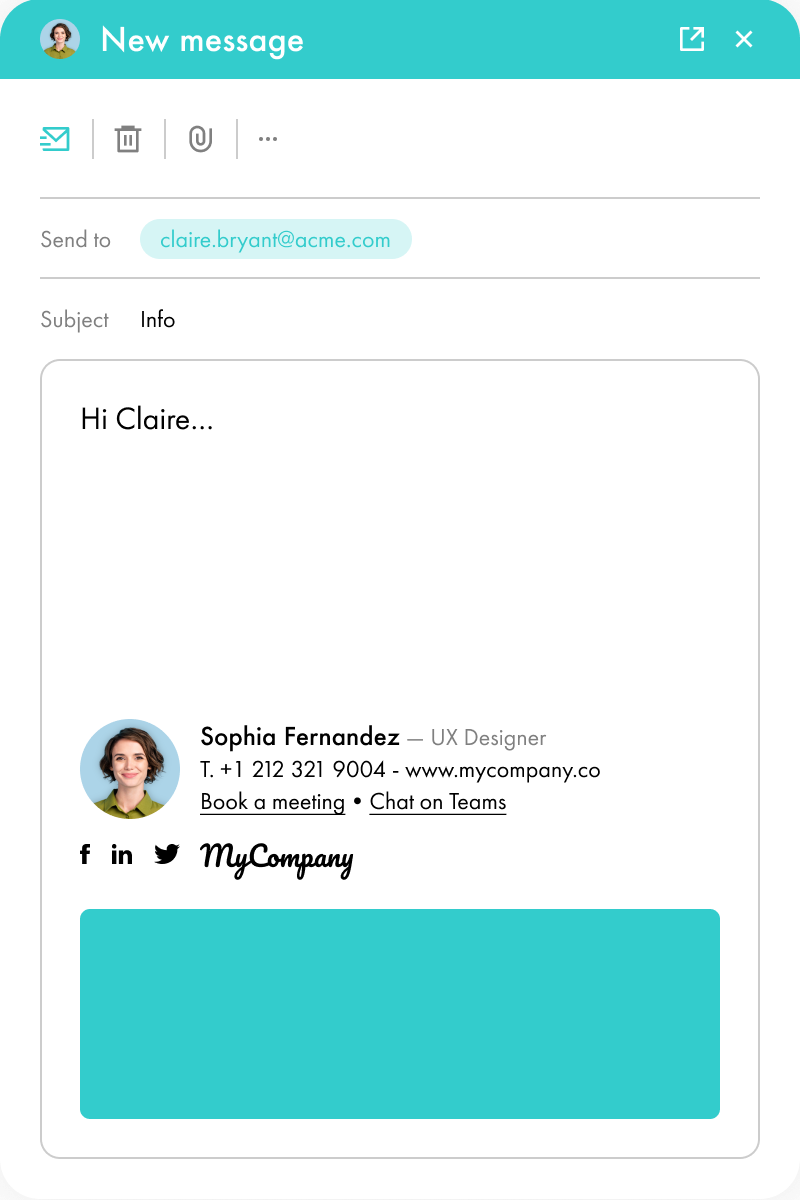
With Letsignit, you can easily add social network icons in your collaborators' email signatures and link to your company pages. Also, our "attributes" feature allows you to manage personalized URLs for each of your collaborators such as their individual LinkedIn profile.
And that's not all: you can add links to an appointment-setting application, allow your customers to leave reviews easily, and integrate our 'Chat on Teams' widget to let anyone start a discussion via Microsoft Teams chat.
It’s up to you! As an administrator of the Letsignit platform, you choose whether or not to grant modification rights to your employees. These permissions are managed on an attribute-by-attribute basis, which means that you can decide to allow the employee to change their phone number, but not the address of your premises, for example.
This feature applies to all attributes in your directory, including custom attributes created on Letsignit. When your employees change one or more attributes, your directory is obviously not affected.
It often happens that employees make their email signature their own: custom format, bad fonts, colors inconsistent with the brand standards... all of this has an impact on your brand!
A consistent visual identity is considered authentic and outperforms a perceived weak one by 20%. And, your customers are 2.4 times more likely to buy your products.
With Letsignit, take back control over your brand identity by standardizing all your email signatures. Our tool has many features that allow you to customize your signatures by department, by audience or by subsidiary. Not to mention the possibility of carrying out campaigns within your email signatures thanks to our Campaign offer.
What is the user experience like for our employees?
In both cases:
In short, they have autonomy in their email signature, but you keep control on the field, signatures, and banners they can edit or use.
With our "multi-signature" feature, your employees can benefit from multiple email signatures. No technical manipulation is required. Thanks to our Add-in for Outlook or the desktop app, they can change their email signatures as they wish with just a few clicks.
Regarding the creation of email signatures, you can make several variations such as:
Everything has been thought of to go further in the personalization process based on the recipient of your emails.
If sending emails has an impact, non-optimized email signatures also have an impact. An unsuitable format or an image that is too heavy considerably increases the size of your signatures... and therefore, your emails.
As a responsible economic actor, we contribute to reducing our CO2 emissions and those of our customers in several ways:
As we are increasingly involved in sustainability initiatives, our priority in 2023 is to develop even more green IT functionality.
If sending emails has an impact, non-optimized email signatures also have an impact. An unsuitable format or an image that is too heavy considerably increases the size of your signatures... and therefore, your emails.
As a responsible economic actor, we contribute to reducing our CO2 emissions and those of our customers in several ways:
As we are increasingly involved in sustainability initiatives, our priority in 2023 is to develop even more green IT functionality.
Employer branding is the way a company builds and communicates its identity as an employer. It shapes how current and future employees perceive the company, from its culture and values to the overall employee experience.
Your corporate brand shapes how customers and the general public perceive your company. Your employer brand focuses specifically on how people perceive you as an employer. The two are closely connected, but they address different audiences and objectives.
Employer branding is a shared responsibility. HR and communications teams often lead the strategy, but managers, leadership teams, and employees all play an important role in bringing the employer brand to life.
The four P’s of employer branding are Promise, People, Place, and Promotion. Together, they cover what you offer employees, the people and culture they join, the working environment, and how you communicate your employer brand.
Yes! Salesforce, Patagonia, and LEGO are well-known examples of companies with strong employer brands. Their strength lies in having a clear identity, a distinctive employee experience, and a relatively strong alignment between what they communicate and what employees experience.
An employer branding agency can be particularly valuable when you need to define your employer value proposition (EVP), strengthen your reputation as an employer, attract talent in a competitive market, or build a comprehensive employer branding strategy.
There is no single career path into employer branding. Experience in HR, recruitment, marketing, communications, content, or social media can all be relevant. Strong communication skills, creativity, strategic thinking, and a good understanding of candidate and employee expectations are key assets.


Lorem ipsum dolor sit amet, consectetur adipiscing elit, sed do eiusmod tempor incididunt ut labore et dolore magna aliqua. Ut enim ad minim veniam, quis nostrud exercitation ullamco laboris nisi ut aliquip ex ea commodo consequat. Duis aute irure dolor in reprehenderit in voluptate velit esse cillum dolore eu fugiat nulla pariatur.